Looking for caps for Rain Bird sprinkler heads? Learn the difference between replacement caps and protective guards, and which one actually stops mower damage.
⏱ 8 min read · Last updated September 2026
Ken Kwiatkowski
Founder of GRASSHOLE Corporation & inventor of the Sprinkler-Guard
Veteran. Florida homeowner who got tired of replacing the same broken sprinkler heads every season. Featured by Kevin Harrington (from Shark Tank). Recipient of the JMI 30 Award. Manufactures in Bradenton, Florida.
Full disclosure: GRASSHOLE Corporation manufactures the Sprinkler-Guard discussed in this guide. Our recommendations come from years of field testing and customer feedback.
Table of Contents
If you’re searching for caps for Rain Bird sprinklers, you’re dealing with one of two things: a broken head that needs a replacement cap, or an intact head you want to protect before the next mower pass clips it. Both situations have a fix — but only one of them actually stops the repair cycle.
You’ve probably already replaced at least one. Rain Bird heads are solid, but the cap is always the first piece to go. A mower wheel rolls over it, a trimmer catches the top, and suddenly your zone is gushing sideways into the driveway instead of watering the lawn.
According to LawnLove, professional sprinkler head replacement costs between $59 and $150 per head. On a yard with 15 to 20 heads, that adds up faster than most homeowners expect.
What “Caps for Rain Bird Sprinklers” Actually Means
The phrase covers two different problems, and they need different solutions.
Replacement caps are Rain Bird-branded parts that swap onto a damaged head body. If the head got hit hard, the cap cracks first — it’s the top piece that takes the blow. Rain Bird sells replacement caps and nozzles for most of their 1800-series spray heads and 5000-series rotors. You can find them at irrigation suppliers for a few dollars each. This fixes the immediate problem but leaves the head just as exposed as it was before.
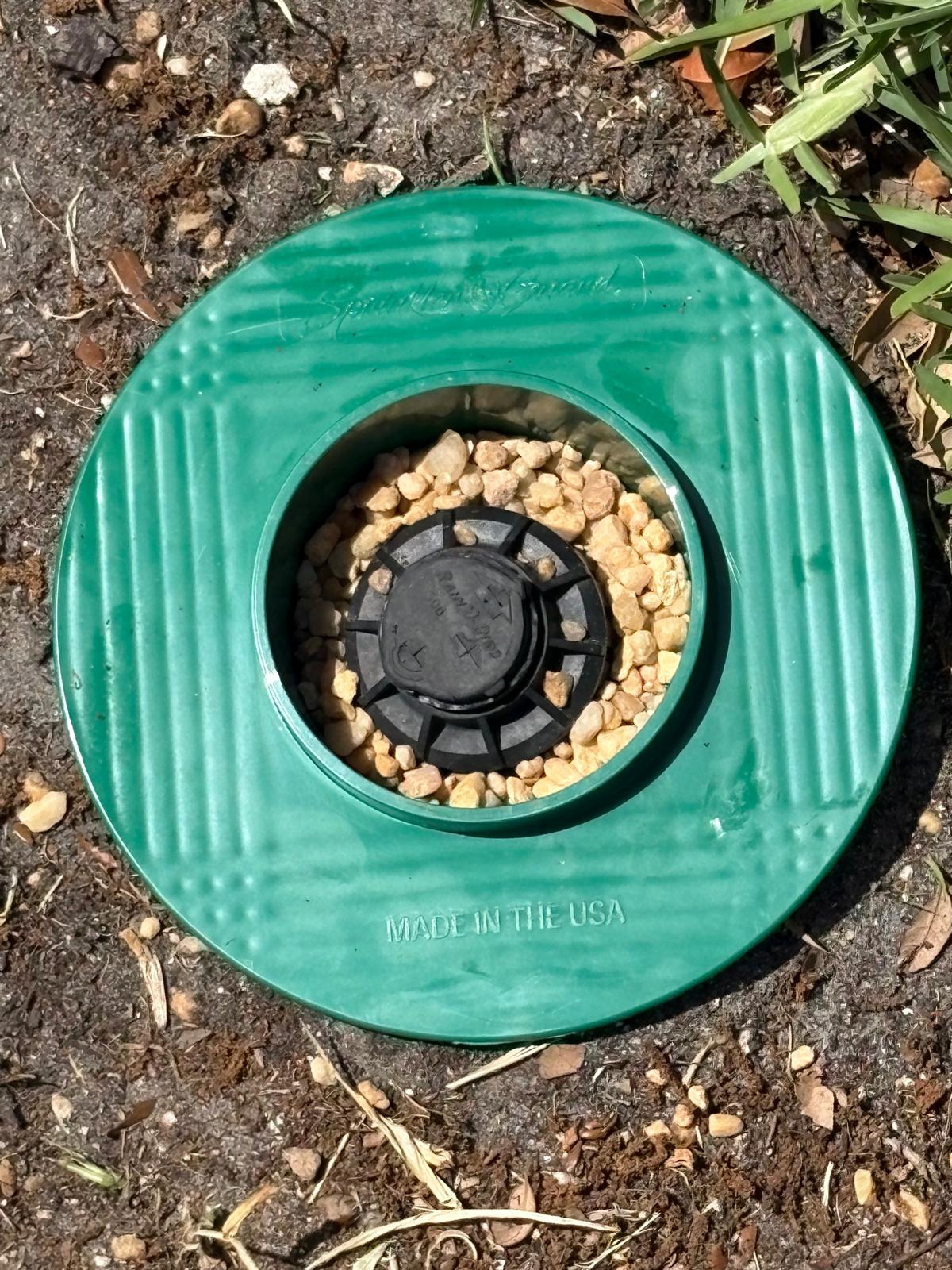
Protective guards are a different category entirely. These are flexible ring-shaped barriers you press into the soil around each head. The mower blade and trimmer hit the ring instead of the head cap. The cap stays intact. No replacement needed.
Most homeowners start with the first option. Then they replace the same heads again a season later. That’s usually when they start looking for the second.
Why Rain Bird Caps Keep Breaking
The cap problem isn’t bad luck. It’s geometry.
Rain Bird pop-up heads sit just above soil level when they’re retracted between cycles. That low profile is the design — it lets the head pop up when the zone fires without creating a permanent obstacle. But that same low profile puts the cap right in the path of a mower deck or trimmer line every time you cut the grass.
Here’s what usually causes it:
Mower impact. Even a well-set mowing height leaves little clearance over a slightly high or tilted head. If the head has heaved up over winter or drifted out of alignment, the cap is right where the blade passes.
String trimmer passes. You can’t mow right up to the head without risking damage, so most people finish the circle with a trimmer. At high RPMs, a trimmer cord hits the plastic cap with enough force to chip it or crack it clean across.
Soil settlement. Heads shift. Rain, root growth, and freeze-thaw cycles move the soil under the head body. A head that sat flush in October may be sticking up an inch by spring.
Foot traffic. Kids running the yard, pets, anyone stepping near a head when the soil is wet. The riser can bend or the cap can crack from direct weight.
A single broken sprinkler head can waste up to 25,000 gallons of water per year, according to EPA WaterSense. A cracked cap that sprays sideways instead of up starts burning through that number fast — usually before you even notice the zone is off.
Two Ways to “Cap” a Rain Bird Head
| Method | What it does | Stops the next hit? | Main problem |
|---|---|---|---|
| Rain Bird replacement cap | Swaps out cracked cap | No | You’re back to square one |
| Concrete sprinkler donut | Rings the head with concrete | Partially | Sinks over time, grass covers it |
| PVC pipe ring (DIY) | Circle of pipe around head | Barely | Shifts, unstable, temporary |
| Sprinkler-Guard by GRASSHOLE | Flexible ABS ring absorbs the hit | Yes | None — this is the fix |
Replacement caps are repair, not prevention. Concrete donuts are the old-school answer, but according to SprinklerBuddy, they tend to sink into the ground over time, get covered by grass, and stop working without you realizing it. The PVC pipe method works until the pipe shifts or gets stepped on.
The option built specifically to break the repair cycle is a flexible guard ring. The head pops up through the center when the zone fires, works normally, then drops back down. The ring stays at ground level between cycles, taking the hit that would have gone to the cap.
| Time period | Replace caps/heads as needed | With Sprinkler-Guard |
|---|---|---|
| Single professional repair visit | $59 – $150 per head | $6.50 one-time |
| Annual sprinkler maintenance cost | $175 – $285 plus replacements | $175 – $285, no replacements |
| Full system replacement cost | $3,000 – $10,000 | System lasts full 15-20 year lifespan |
The repair costs are from LawnLove and HomeGuide. The point isn’t a complicated ROI calculation — it’s that a guard costs less than a single service call.
How to Install a Protective Guard on a Rain Bird Head
Total time needed: about 6 minutes.
- Step 1: Run the Zone Briefly
Fire the zone for 10-15 seconds so the heads pop up, then shut the zone off. This lets you see which heads are in the area and confirms they're working before you install anything.
- Step 2: Clear Around the Head
Use a trowel or your hands to pull back any grass, mulch, or soil that's crept over the head. The guard needs to sit flush at soil level with the head centered in the opening. If there's buildup around the head, the guard will sit too high and won't stop low impacts.
- Step 3: Press the Guard Into Place
Slide the Sprinkler-Guard ring over the head and press it down into the soil. The inner lip of the ring sits around the head body; the outer flange sits flat at ground level. No tools, no digging, no plumbing. About 30 seconds per head. When the zone fires, the head pops up through the center and sprays normally. When it retracts, it drops back through the same opening. The guard doesn't touch the nozzle or block the spray pattern.
What Size Works for Rain Bird Heads
The standard 3-inch Sprinkler-Guard fits any pop-up spray head up to 3 inches in diameter. That covers Rain Bird 1800-series sprays, which are the most common residential spray heads.
Rain Bird 5000-series rotors are larger. For those, the 5-Inch Sprinkler-Guard fits heads up to 5 inches wide. It uses the same design, just scaled up. It also works with Hunter PGP rotors and most other residential rotor heads.
If your yard has a mix of spray heads and rotors — common in Sun Belt homes with larger lots — you need both sizes. Our guide to the best sprinkler head protectors has a comparison of sizing options if you’re not sure what you have.
The 3-inch guard is made from Flexible Advance ABS with UV Deterrent. The 5-inch version uses Flexible ABS. Both are patented, Veteran-Owned, Made in USA, and sold in 10-pack, 20-pack, 30-pack, and 60-pack configurations at Sprinkler-Guard.com. Orders over $100 ship free.
Most homeowners with a standard residential lot have somewhere between 12 and 25 heads, according to HomeGuide. A 20-pack handles most full-yard systems in one shot. If you have rotors, add a 10-pack of the 5-inch alongside.
After replacing four heads in two seasons, I started looking for a real fix. Turns out the fix was already available and cheaper than a single service call. Now I just mow, and the heads are still there when I’m done.
— Ken Kwiatkowski, founder, Sprinkler-Guard by GRASSHOLE
Keeping Grass from Growing Over the Guards
Once the guards are in, grass will still try to grow over them — just slower than it grew over bare heads. The ABS ring inhibits creep, but grass bridges the flange edge over time.
A quick pass with a hand trimmer around each guard every few weeks keeps them clear. If heads have already been buried before you installed guards, check our piece on how to find hidden sprinkler heads first — it covers the detection method that works without digging up half the yard.
For more on the grass overgrowth problem specifically, how to stop grass growing over sprinkler heads goes deeper on trimming timing and what to do when the head is fully buried.
Frequently Asked Questions
Yes for most residential types. The 3-inch guard fits any pop-up head up to 3 inches in diameter, which covers Rain Bird 1800-series spray heads. For larger Rain Bird 5000-series rotors, the 5-inch guard fits heads up to 5 inches wide.
A replacement cap is a repair — you swap it in after the cap breaks. A protective guard goes around the intact head before anything breaks, so the cap never gets hit. One fixes what happened; the other prevents it from happening again.
No. The guard presses into place by hand — no digging, no fasteners, no plumbing. About 30 seconds per head. You don't need to cut the zone or drain the lines.
No. The guard sits at ground level and stays there when the zone fires. The head pops up through the center opening and sprays normally. The guard doesn't touch the nozzle or restrict water flow.
If the head has sunk below grade, fix that first before installing the guard. A guard placed around a sunken head will sit too low and won't protect from above-grade impact. Once the head is back at the right height, the guard goes in normally.
Most residential yards have between 12 and 25 heads, per [HomeGuide](https://homeguide.com/costs/sprinkler-head-replacement-cost). A 20-pack from [Sprinkler-Guard.com](https://sprinkler-guard.com) covers most full-yard systems. Add a 10-pack of the 5-inch if you have rotors.
The Flexible Advance ABS flexes under impact instead of shattering. If a guard ever takes too much abuse, you replace just that one guard — not the full head plus a service call. That's the whole point of the one-by-one swap design.
The Bottom Line
Replacing Rain Bird caps is a maintenance task with no end date if you don’t change something. The cap absorbs what it can, breaks, you replace it, repeat. A protective guard changes that equation: the ring takes the hit, the head stays intact, and you stop budgeting for repair calls.
The Sprinkler-Guard by GRASSHOLE installs in 30 seconds per head with no tools. Made in USA, Veteran-Owned, Patented, and backed by 500+ five-star ratings from homeowners who made the same calculation. Check sizes and pack options at Sprinkler-Guard.com — free shipping on orders over $100.
Not sure? The Sprinkler-Guard ships in 10/20/30/60-packs. If one ever takes too much abuse, you swap just that one in 30 seconds — no full system to replace.
Shop Sprinkler-Guard
- Starting at $64.99 for a 10-pack
- Free shipping on orders over $100
- 500+ five-star ratings from homeowners on Amazon
- Made in the USA by a Veteran-Owned Business in Bradenton, Florida
- Patented design — featured by Kevin Harrington (from Shark Tank)
- No tools required — installs in 30 seconds per head
- One-by-one swap design — if a guard takes too much abuse, swap just that one
Last updated: September 2026. Statistics sourced from EPA WaterSense, Johns Hopkins Medicine, LawnStarter, LawnLove, HomeGuide, IBISWorld. Product specifications and pricing current as of publication date.