The Kap-It sprinkler riser cap protects your head from direct impact. But for pop-up systems, a full head guard at turf grade stops more damage for the same cost.
⏱ 9 min read · Last updated September 2026
Ken Kwiatkowski
Founder of GRASSHOLE Corporation & inventor of the Sprinkler-Guard
Veteran. Florida homeowner who got tired of replacing the same broken sprinkler heads every season. Featured by Kevin Harrington (from Shark Tank). Recipient of the JMI 30 Award. Manufactures in Bradenton, Florida.
Full disclosure: GRASSHOLE Corporation manufactures the Sprinkler-Guard discussed in this guide. Our recommendations come from years of field testing and customer feedback.
Table of Contents
If you’re searching for the Kap-It sprinkler riser, you’ve already identified the core problem: your irrigation risers keep getting cracked, knocked sideways, or buried under grass. Riser caps try to solve this by covering the exposed pipe assembly. But capping only the top of the riser leaves the head and the surrounding soil unprotected. Here’s what actually stops the damage.
Every homeowner with a lawn sprinkler system eventually hears that crunch. You’re making a pass near the beds, wheel catches a riser, and you already know what you’re going to find when you check. According to LawnLove, professional sprinkler head replacement runs $59 to $150 per head, with a full service call running $130 to $275 once you add labor.
Products like the Kap-It sprinkler riser cap exist to prevent exactly that. The concept is sound: cover the exposed top of the riser to shield it from mower wheels and trimmer line. These products work for what they do. The question is whether riser-only coverage addresses the full problem — and for most homeowners, it doesn’t quite get there.
What Is a Sprinkler Riser — and Why Does It Keep Breaking?
A sprinkler riser is the short pipe section that connects your underground supply line to the sprinkler head above grade. On fixed-head setups, the riser stands exposed 2 to 4 inches above the lawn. On pop-up systems, the body sits below grade and the head extends only when the zone is running.
Either way, the riser is the weakest point in your system — and it’s under attack from multiple directions every time you mow.
Lawn mowers are the number one cause
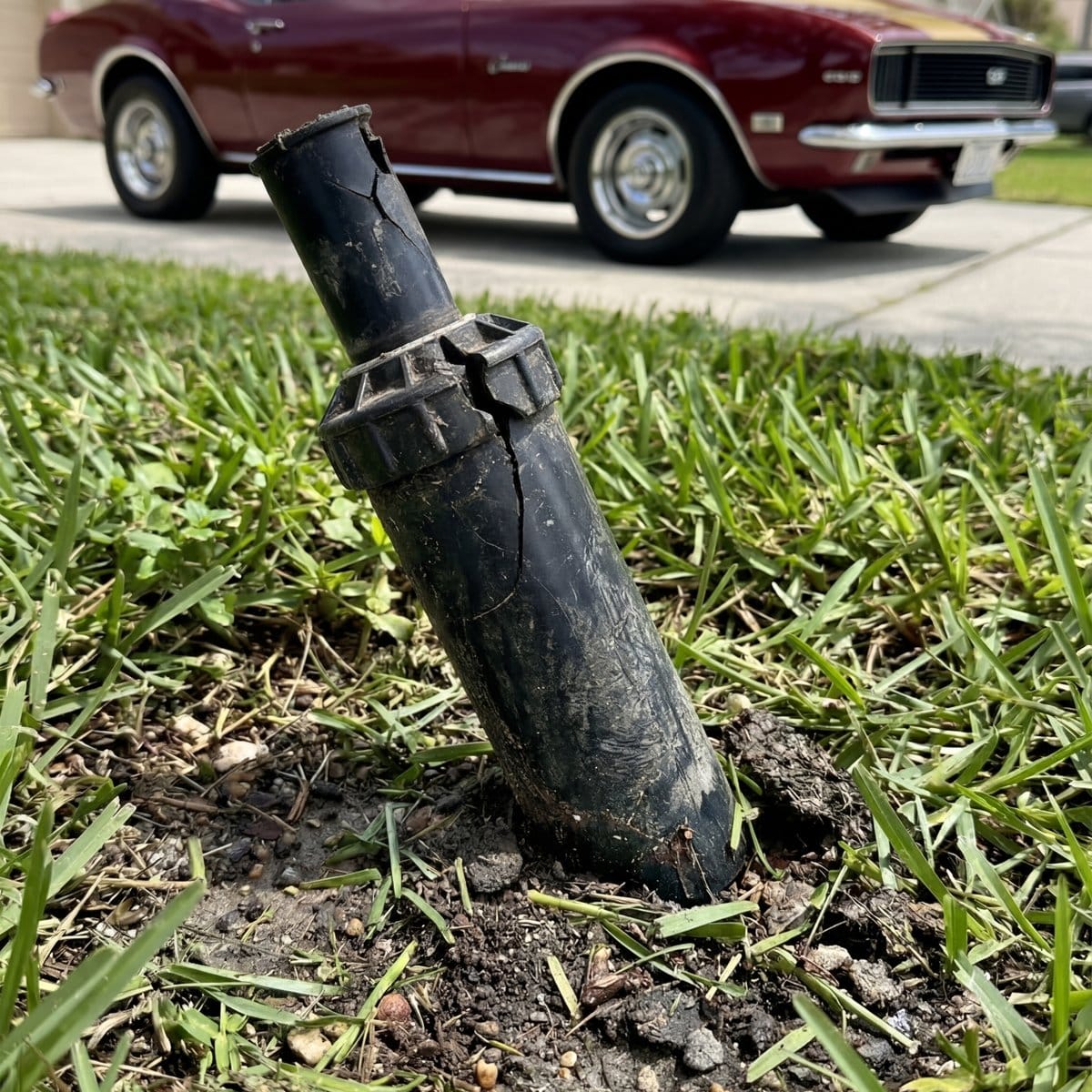
Irrigation professionals consistently identify lawn mowers as the leading cause of sprinkler head and riser damage, per Texas Rainmakers. The mower deck catches the top of a riser, a wheel rolls directly over it, or the blade clips it on a close pass. The result is a cracked riser at the coupling, a sheared-off head, or a riser now sitting at an angle — which will get hit again on the next pass.
I’ve replaced my share of these. The frustrating part isn’t the part itself. It’s that you don’t always notice until the zone runs and there’s a 3-foot spray going sideways instead of the pattern you set up.
Exposed risers settle and shift
Florida sandy soil and Southeast clay both shift under irrigation pressure over time. A riser that’s perfectly set in March may be sitting proud of grade by July, or tilted where the soil has settled around one side. Once the head is above the mower deck’s clearance line, you’re going to make contact — it’s just a matter of when.
If your sprinkler heads keep sinking or tilting over the course of a season, our guide on why sprinkler heads keep sinking covers the soil and installation factors in more detail.
String trimmers finish what mowers start
The weed trimmer is the second most common culprit. Most homeowners mow carefully around sprinkler heads but then run the trimmer right at the base to knock down the grass that grows in close. One pass too low and the riser snaps at the coupling. Per LawnStarter, DIY replacement parts run $3 to $30 — but that only helps if you catch the break before the zone runs.
A single broken sprinkler head can waste up to 25,000 gallons of water per year, according to the EPA WaterSense program. That’s not a slow drip — that’s a full geyser running every time your irrigation controller fires that zone.
What the Kap-It Approach Tries to Solve
Riser caps like the Kap-It work by covering the exposed top of the riser assembly — the point where the head screws on or snaps in. The product creates a physical barrier over the most vulnerable part of the connection. For fixed-head risers that stand above grade, this reduces direct impact on the head itself.
The engineering is real. If your mower blade clips the cap instead of the riser thread, you’ve protected the most expensive-to-replace part of the assembly.
Where riser-only coverage falls short
The limitation is coverage area. A cap on the top of the riser doesn’t address what’s happening at ground level — grass growing in around the base of the head, the riser shifting in soft soil, or the mower wheel rolling directly over the exposed pipe body below the cap.
For in-grade pop-up sprinklers, a riser cap that sits above the head may not align properly with how the head retracts. Pop-up heads are designed to sit flush with grade when the zone is off. A cap perched above the assembly can catch the mower deck even when the head itself is safely below the blade.
The grass coverage problem most products miss
After a few weeks of summer growth, grass grows into and over unprotected heads. Once the head is buried, you can’t see it while mowing — and neither can your landscaper. The grass that grows over sprinkler heads actually accelerates damage by causing repeat hits at the same spot. Our full guide on stopping grass from growing over sprinkler heads covers the trimming and protection approaches side by side.
Head Guard vs. Riser Cap: What Each Protects
This comparison is where most homeowners find clarity on what they actually need:
| Feature | Riser Cap (Kap-It style) | Sprinkler-Guard by GRASSHOLE |
|---|---|---|
| Protects head from direct mower contact | ✓ | ✓ |
| Absorbs lateral impact from mower wheels | Limited | ✓ (Flexible Advance ABS with UV Deterrent) |
| Inhibits grass from growing over the head | No | ✓ |
| Helps keep head at grade level | No | ✓ |
| Works with in-grade pop-up heads | Limited | ✓ |
| Sits flush with turf to clear mower deck | No | ✓ |
| Install time | 2-3 min | 30 seconds |
The Sprinkler-Guard by GRASSHOLE sits around the base of the head at turf grade. The mower deck passes over the guard’s low-profile ring instead of contacting the riser or head at all. The guard’s flange also inhibits grass from growing into the head assembly between mowings, which reduces the grass burial problem that makes riser damage more likely over time.
For a full breakdown of how the Sprinkler-Guard compares to other protection options, including concrete donuts and similar competitors, see our best sprinkler head protectors ranked guide.
How to Protect Your Sprinkler Heads (Step-by-Step)
Replacing a riser cap with a full head guard takes about 30 seconds per head with no tools. Here’s the process:
Step 1: Remove the existing cap or hardware
Pull off any existing riser cap, concrete donut, or temporary protection. Clear grass that’s grown into the base of the head so you can see the body of the assembly.
Step 2: Slide the Sprinkler-Guard over the head
The Sprinkler-Guard slides down over the sprinkler head from the top. It fits any pop-up head up to 3 inches wide. For rotor heads, the 5-Inch Sprinkler-Guard covers heads up to 5 inches — useful for Rain Bird 5000 and Hunter PGP rotors.
Step 3: Press it flat into the turf
Press the guard down until the outer flange sits flush with the lawn surface. On soft soil this goes quickly. On packed ground, use your palm to seat it evenly around the head. The ring should be flush — not sticking up above the grass line.
Step 4: Run the zone to confirm clearance
Fire the irrigation zone and watch the head pop up through the guard’s inner opening. The 3.5-inch opening gives full clearance for the head to extend and spray normally. If the head operates cleanly, you’re done.
What Protection Costs vs. What It Saves
Most homeowners don’t run the numbers until after they’ve had a few repair bills. Here’s the math over time, with professional replacement at the $130-$360 range per service call (LawnStarter):
| Scenario | Year 1 | Year 3 | Year 5 |
|---|---|---|---|
| No protection — repair calls as needed | $130-$360/call | $390+ | $650+ |
| Riser caps only — reduced but not eliminated | $65-$180/call | $195+ | $325+ |
| Sprinkler-Guard 20-pack on all heads | $125 one-time | $125 total | $125 total |
The 20-pack covers most standard residential lots. At $125, that’s the same as one service call in the low range. After that, you’re not on the phone with the irrigation company every spring.
Frequently Asked Questions
**The Kap-It sprinkler riser is a protective cap designed to cover the top of an exposed irrigation riser**, shielding the head assembly from direct impact by lawn mowers and trimmers. It works best on fixed-head setups where the riser pipe stands above grade. For in-grade pop-up systems, a full head guard that sits flush with the lawn surface provides more complete protection from multiple damage vectors.
**Pop-up heads retract below grade when the zone is off**, so a cap that sits above the assembly provides less coverage than the cap's design suggests. For pop-up heads, a guard that absorbs lateral impact at turf grade — from mower wheels, edger blades, and heavy foot traffic — is a better fit. The Sprinkler-Guard by GRASSHOLE is designed specifically for in-grade pop-up installations.
**No — water output is unaffected.** The Sprinkler-Guard's 3.5-inch inner opening allows the head to extend fully and spray normally. Run your zone after installing and the head should pop up through the opening without restriction. If you see a noticeable change in spray pattern, check that the guard is seated evenly around the head.
Most residential irrigation systems have between 12 and 30 heads. For full yard coverage, the 20-pack handles most standard-size residential lots. Larger properties or multi-zone systems often use the 30-pack or 60-pack, which brings the per-head cost down. If you're not sure how many heads you have, run each zone and count while they're up.
**Yes — with the 5-Inch size.** The original Sprinkler-Guard fits spray heads up to 3 inches wide. The 5-Inch Sprinkler-Guard fits rotor heads with a wider body, including the Rain Bird 5000 and Hunter PGP. Measure the head at its widest point when fully retracted — if it's under 3 inches, the original size works. If it's between 3 and 5 inches, go with the 5-inch version.
**Concrete donuts crack, sink, and let grass bury the head over time.** The weight of concrete accelerates soil settlement around the riser, the ring sinks below grade, and grass covers it within a season. The Sprinkler-Guard uses Flexible Advance ABS with UV Deterrent — it absorbs mower and trimmer impact instead of crumbling, and the flat flange sits at grade to inhibit grass from growing in around the head. For a full comparison, see our [concrete donuts vs. Sprinkler-Guard breakdown](https://grassholesystem.com/concrete-donuts-vs-sprinkler-guard/).
**Replace just that one.** The Sprinkler-Guard is sold in packs but each guard works independently. If one takes a hard enough hit to show wear, pull it out and drop in a new one. You're not replacing the full set — just the one that caught the abuse.
**Yes — spray heads are typically narrower than rotors.** Standard spray heads are usually under 3 inches wide and the original Sprinkler-Guard covers them. Rotor heads like the Rain Bird 5000 have a larger body diameter and need the 5-Inch Sprinkler-Guard. If you're mixing head types across zones, pick up both sizes to match what you have.
The Bottom Line
The Kap-It sprinkler riser and similar riser caps solve a real problem — direct impact on an exposed head. If you have fixed-head risers standing above grade, a riser cap is a reasonable first step. But most residential irrigation systems use in-grade pop-up heads, and riser-only caps don’t address the full picture: grass growing over the head, lateral impact from mower wheels, and soil shifting around the riser base over time.
A full head guard that sits at turf grade — like the Sprinkler-Guard by GRASSHOLE — absorbs impact from every direction, inhibits grass coverage, and keeps the head visible and accessible year-round. The 20-pack covers most yards for $125, about the same as one service call. Pick one up at Sprinkler-Guard.com and stop paying the irrigation tech to fix the same heads every spring.
Not sure? The Sprinkler-Guard ships in 10/20/30/60-packs. If one ever takes too much abuse, you swap just that one in 30 seconds — no full system to replace.
Shop Sprinkler-Guard
- Starting at $64.99 for a 10-pack
- Free shipping on orders over $100
- 500+ five-star ratings from homeowners on Amazon
- Made in the USA by a Veteran-Owned Business in Bradenton, Florida
- Patented design — featured by Kevin Harrington (from Shark Tank)
- No tools required — installs in 30 seconds per head
- One-by-one swap design — if a guard takes too much abuse, swap just that one
Last updated: September 2026. Statistics sourced from EPA WaterSense, Johns Hopkins Medicine, LawnStarter, LawnLove, HomeGuide, IBISWorld. Product specifications and pricing current as of publication date.