Lawn sprinkler heads take daily abuse from mowers and trimmers. Learn how they work, why they break, and the best way to protect them and save on repairs.
⏱ 11 min read · Last updated September 2026
Ken Kwiatkowski
Founder of GRASSHOLE Corporation & inventor of the Sprinkler-Guard
Veteran. Florida homeowner who got tired of replacing the same broken sprinkler heads every season. Featured by Kevin Harrington (from Shark Tank). Recipient of the JMI 30 Award. Manufactures in Bradenton, Florida.
Full disclosure: GRASSHOLE Corporation manufactures the Sprinkler-Guard discussed in this guide. Our recommendations come from years of field testing and customer feedback.
Table of Contents
Lawn sprinkler heads are the most vulnerable part of your irrigation system. They sit at ground level where mowers, trimmers, and foot traffic can reach them every single week. Most homeowners don’t think about them until something breaks. Here’s what to know, and how to stop the damage before it starts.
If you’ve got a sprinkler system, the odds are good you’ve already replaced at least one head. The average homeowner spends $130 to $360 on sprinkler system repairs, according to LawnStarter, and damaged heads are the most common repair of all. Most of that damage was preventable.
This guide covers how lawn sprinkler heads work, what causes them to fail, the warning signs to watch for, and what you can do to keep yours working the way they should.
What Lawn Sprinkler Heads Actually Do
Most residential irrigation systems use pop-up sprinkler heads — the kind that sit flush with the ground and rise a few inches when water pressure builds. When the zone kicks on, they pop up, water the area, then retract back into the ground. Simple in theory. But that up-and-down cycle, repeated hundreds of times a season, is exactly what makes them vulnerable.
There are a few main types in residential yards:
Spray heads are the most common. They pop up and spray a fixed fan of water — quarter-circle, half-circle, or full-circle arcs depending on how they’re positioned. They work well for smaller lawn sections and planting beds. When they break, it’s usually the cap cracking or a leak developing around the riser base.
Rotor heads rotate and throw water in a moving arc across a wider zone. The Rain Bird 5000 and Hunter PGP are common in Sun Belt yards. They tend to be a little more robust than spray heads but they’re not immune to mower impact. A blade that catches one at the wrong angle will crack it just the same.
Impact sprinklers are the older click-and-rotate style. Less common in newer installs but still running in plenty of yards that were put in 20 or 30 years ago.
All three types share the same problem: they live at ground level, in your mowing path, right where everything that can go wrong usually does. They pop up into the striking zone of every mower blade, every trimmer line, and every set of cart wheels that crosses the yard.
Why Lawn Sprinkler Heads Keep Getting Damaged
Most sprinkler damage isn’t dramatic. It builds up over time — a small impact here, a slight push there — until a head stops working right or fails completely. Here’s what’s working against them every week:
The mower is the biggest threat
Lawn mowers are the number one cause of damaged and broken sprinkler heads, according to irrigation professionals at Texas Rainmakers. A blade that clips a head at the wrong angle can snap the cap clean off. But direct contact isn’t even required to cause damage. Mowing vibration pushes heads out of alignment slowly, over weeks and seasons, until the spray pattern is pointing at your driveway instead of your grass.
The wheels do damage too. Drive a mower over wet ground near a sprinkler head often enough and you’ll compress the soil around the riser. That compaction gradually tilts the head, changes the spray angle, and can eventually sink it below grade where the mower catches it on the next pass.
The trimmer finishes what the mower started
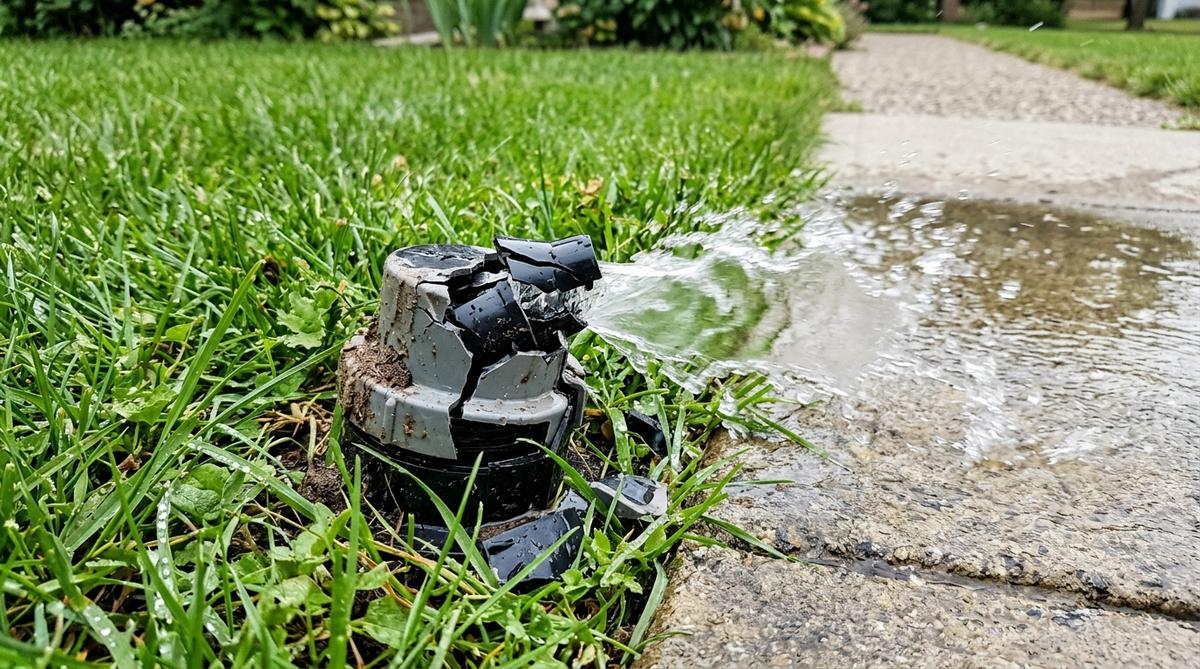
String trimmers spin at high speed at exactly the height where most pop-up heads live. One pass too close and you’ll shear the cap off the top. The result is a broken head that either stops working or sprays sideways at the base instead of through the nozzle.
That sideways leak is more expensive than it looks. A single broken sprinkler head can waste up to 25,000 gallons of water per year, per EPA WaterSense. Running at 9 to 16 gallons per minute when the zone is active, per Resource Central, a broken head adds up fast on a water bill.
Grass grows right over them
Grass doesn’t care where your sprinkler heads are. It creeps in from the sides and eventually covers a head if left alone long enough. Once a head is buried under turf, it can’t pop up fully — and if it does pop up, the grass blades deflect the spray in the wrong direction. More importantly, a buried head becomes invisible to anyone behind a mower. You’re mowing over what looks like flat ground, and the blade finds the plastic cap just below the surface.
For more on managing grass encroachment, see our full guide to stopping grass from growing over sprinkler heads.
Foot traffic and vehicle pressure
A delivery truck cutting across the corner of your lawn, a lawnmower parked on a head, kids running the same worn path every afternoon — all of it applies downward force that the head wasn’t built for. The riser and cap are designed to take water pressure pushing up from below, not impact pushing down from above. One direct compression is sometimes enough to crack the riser and start a slow leak.
Soil settling and sinking
Over months and years, the soil settles around a sprinkler head. The head gradually sinks below grade — sometimes by just a quarter inch, sometimes much more. At that point it’s harder to see, harder to service, and easy for the mower to catch on the next pass. Our post on why sprinkler heads keep sinking covers the soil mechanics behind this in more detail.
Signs Your Sprinkler Heads Need Attention
You don’t always see the damage happen. But your lawn usually tells you within a watering cycle or two. Run each zone manually and look for these:
Water spraying sideways from the base
If water is coming out of the base of an extended head instead of the nozzle, the riser cracked or the cap took a hit. It’s wasting water, losing the pressure other zones need, and not covering the area it’s supposed to cover. That head needs to be replaced before the next cycle.
Brown patches in an otherwise green lawn
A dry spot in a zone that should be watered is almost always a coverage problem. Either a head isn’t extending, one got knocked out of alignment, or a nozzle is clogged with mineral buildup. Walk each zone during a manual run and watch every head in sequence. If you suspect heads are buried in grass and you can’t find them, our guide to finding hidden sprinkler heads walks through the process.
A head that won’t retract after watering
A head that stays up after the zone shuts off has a bent riser or damaged spring. That extended head is sitting right in the mowing path until someone moves it or the mower takes it off. Our post on what sprinkler head repairs typically cost breaks down when it makes sense to DIY and when to call a tech.
The Fix: Protect Your Lawn Sprinkler Heads
Total time needed: about 6 minutes.
- Step 1: Walk your yard during a watering cycle
Turn on each zone manually and watch every head pop up. Note the ones sunk below grade, the ones with grass crowding in around them, and any that are leaking, misaligned, or not extending fully. Those need repair before you add protection. A guard around a broken head doesn't fix the break — it just hides it. Get the bad ones swapped out first, then protect everything.
- Step 2: Clear the grass and set the right height
Before installing a guard, pull back any grass growing around the head so the guard can sit flat on the soil surface. If a head has sunk half an inch or more below grade, adjust the riser extension so the head sits at or just slightly above soil level. A head flush with the ground can be protected effectively. A head buried two inches below grade needs to be raised first.
- Step 3: Install a sprinkler head guard around each one
A sprinkler head guard sits around the head at soil level, absorbs mower and trimmer impact before it reaches the head, and slows the grass from growing back over the opening. The [Sprinkler-Guard by GRASSHOLE](https://sprinkler-guard.com) drops into place in about 30 seconds with no tools required. The body is made from Flexible Advance ABS with UV Deterrent — when the mower clips it, it flexes and absorbs the hit instead of cracking. The head pops up through the center and retracts normally. The flat flange stays on the soil surface and gives the grass something harder to creep across. A 20-pack at $125 covers up to 20 heads at $6.25 each. One professional service call to replace a single damaged head typically runs $130 to $275 in parts and labor, per [LawnLove](https://lawnlove.com/blog/sprinkler-repair-cost/). If the guards prevent even one repair call, they've paid for themselves.
Frequently Asked Questions
**The three main types are spray heads, rotor heads, and impact sprinklers.** Spray heads are the most common in residential yards — they pop up and emit a fixed arc of water in a quarter-circle, half-circle, or full-circle pattern. Rotor heads rotate and cover a wider area with a sweeping stream, making them the usual choice for open turf zones. Impact sprinklers are an older click-and-rotate design still running in many yards built before the 2000s. All three types sit at ground level and face the same vulnerability to mowing and trimmer damage.
**Professional replacement typically runs $59 to $150 per head** for parts and labor, according to [LawnLove](https://lawnlove.com/blog/sprinkler-repair-cost/). With a service call fee included, a single visit to replace one damaged head often comes out to $130 to $275 total. DIY replacement costs $3 to $30 in parts if you know the head model, can match the brand and spray radius, and are comfortable digging around a zone that's been shut off. The labor is what makes professional service expensive.
**Look for water spraying sideways from the base, a head that won't pop up at all, or dry patches in an otherwise watered area of the lawn.** Run each zone manually and watch every head come up. A broken or damaged head usually gives itself away immediately — it stays flat, rises crookedly, or has water pushing out at the base instead of through the nozzle. A head that looks fine visually but leaves a dry patch is usually misaligned or has a clogged nozzle.
**No.** A properly fitted guard sits around the outside of the head at ground level and doesn't touch the nozzle, riser, or spray mechanism. The head extends through the center of the guard just as it did before, sprays its full pattern, and retracts on its own when the zone shuts off. The guard only contacts the soil surface and the outer base of the head — nothing that moves or directs water.
**Clear the grass ring around each head manually a couple of times per season, or install a guard that makes it harder for grass to encroach.** Grass naturally creeps in from all sides and will eventually bury a head if nothing stops it. A sprinkler guard's flat flange gives the grass harder material to grow over than bare soil, which slows the regrowth significantly. See our full guide to [stopping grass from growing over sprinkler heads](https://grassholesystem.com/stop-grass-growing-over-sprinkler-heads/) for the complete rundown.
**Most quality heads last 10 to 15 years under normal use**, per [HomeGuide](https://homeguide.com/costs/sprinkler-head-replacement-cost). That lifespan gets cut short by regular mower and trimmer impact, hard water mineral buildup in the nozzle, and freeze-thaw cycling in colder climates. A protected head that never takes a direct hit can realistically run its full service life. A head that gets clipped by the mower several times a season won't last nearly as long.
**Yes — one avoided service call more than covers a full set of guards.** A 20-pack runs $125, which works out to $6.25 per head. A single professional service call to replace one damaged head typically costs $130 to $275, per [LawnLove](https://lawnlove.com/blog/sprinkler-repair-cost/). If guards prevent even one of those calls over the course of a season, you've come out ahead. The 500+ five-star ratings from homeowners on Amazon tell the same story — people who've installed them stop replacing heads.
**Turn on each zone manually and mark where the water appears.** Buried heads often reveal themselves as low-pressure wet spots or sideways misting near ground level. You can also probe the lawn methodically with a screwdriver at regular intervals in areas you know should have coverage — the screwdriver will hit plastic before it hits six inches of soil. For a full walkthrough of the process, including how to identify zone boundaries and map head locations, see our guide to [finding hidden sprinkler heads](https://grassholesystem.com/find-hidden-sprinkler-heads/).
The Bottom Line on Lawn Sprinkler Heads
Pop-up heads are easy to forget about. They work automatically, they disappear between waterings, and they don’t ask for much. But they take a beating every single mowing season — from blades, from vibration, from trimmer lines, and from grass creeping in from every direction.
The fix is straightforward: walk the yard once with the system running, find every head, repair anything that’s already broken, and put a guard around the rest. A 20-pack from Sprinkler-Guard.com covers a typical yard for $125 total — less than what a single service call usually costs. It’s the kind of one-afternoon fix that buys you years of not thinking about it again.
Not sure? The Sprinkler-Guard ships in 10/20/30/60-packs. If one ever takes too much abuse, you swap just that one in 30 seconds — no full system to replace.
Shop Sprinkler-Guard
- Starting at $64.99 for a 10-pack
- Free shipping on orders over $100
- 500+ five-star ratings from homeowners on Amazon
- Made in the USA by a Veteran-Owned Business in Bradenton, Florida
- Patented design — featured by Kevin Harrington (from Shark Tank)
- No tools required — installs in 30 seconds per head
- One-by-one swap design — if a guard takes too much abuse, swap just that one
Last updated: September 2026. Statistics sourced from EPA WaterSense, Johns Hopkins Medicine, LawnStarter, LawnLove, HomeGuide, IBISWorld. Product specifications and pricing current as of publication date.