Rain Bird sprinkler heads are reliable, but mowers and trimmers still crack them. Learn which types you have, what damages them, and how to protect them.
⏱ 8 min read · Last updated September 2026
Ken Kwiatkowski
Founder of GRASSHOLE Corporation & inventor of the Sprinkler-Guard
Veteran. Florida homeowner who got tired of replacing the same broken sprinkler heads every season. Featured by Kevin Harrington (from Shark Tank). Recipient of the JMI 30 Award. Manufactures in Bradenton, Florida.
Full disclosure: GRASSHOLE Corporation manufactures the Sprinkler-Guard discussed in this guide. Our recommendations come from years of field testing and customer feedback.
Table of Contents

Rain Bird sprinkler heads are among the most widely used residential irrigation components on the market, but they still crack, sink, and get knocked out of alignment by mowers and trimmers. Understanding which type you have and how to protect each head before mowing season is the most straightforward way to avoid repeated repair costs.
Rain Bird has been manufacturing irrigation equipment since 1933, and if your home has an underground sprinkler system, there is a solid chance some of your heads are Rain Birds. For most of the growing season you don’t think about them. They pop up, water the lawn, retract, and disappear. Until one morning you hear that distinct crunch when the mower rolls over the corner of zone three.
Professional sprinkler head replacement runs $59 to $150 per head according to LawnLove, and that’s before the service call charge. With multiple heads across a typical yard, ignoring the problem for even one season can add up fast.
The Most Common Rain Bird Heads in Residential Yards
Not all Rain Bird heads are the same, and identifying which type you have tells you what kind of protection you need.
Rain Bird 1800 Series (Spray Heads)
The 1800 is the most common residential pop-up spray head. It sits flush with the ground when the system is off, pops up two to four inches during a watering cycle, sprays a fixed arc, then retracts when the zone shuts off.
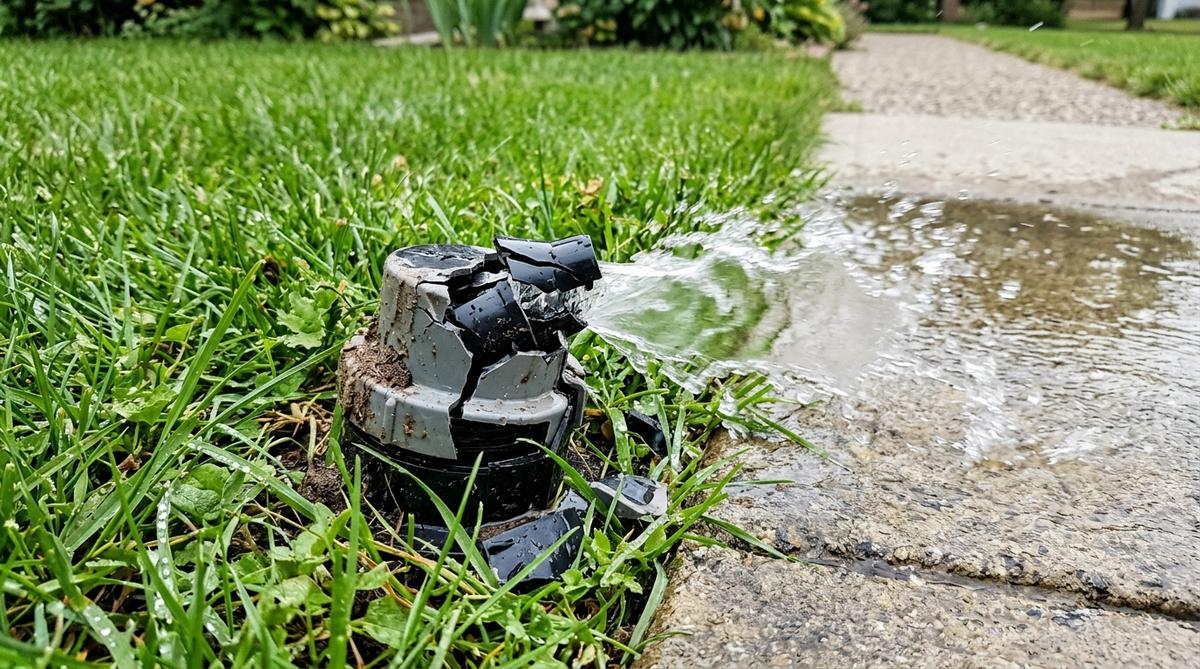
These are the heads that take the most mower damage. At rest, the housing sits at ground level or slightly above. A mower wheel rolling over an exposed 1800 head pushes it sideways. A blade catching the edge of the cap at the right angle cracks the housing straight through.
Rain Bird 5000 Series (Rotary Heads)
The 5000 is a rotor that spins slowly through a circular arc to water a larger area. These heads are bigger than spray heads and have a taller pop-up height. You see them in larger lawns, side yards with long runs, or commercial properties.
Because they are taller and wider, rotor heads sometimes get buried under heavy grass growth. When the head cannot pop up through thick turf, water pressure drops in that zone and spray radius shortens. That grass-overgrowth problem is covered in more detail in the guide on grass growing over sprinkler heads.
Rain Bird 32SA and 42SA Fixed Spray Heads
Less common in newer residential installations but still present in older systems. These are above-ground heads mounted on risers that do not retract. Their exposure makes them the most vulnerable to trimmer strikes and accidental foot traffic. If your system has these, they are the first heads to show damage.
Why Rain Bird Heads Get Damaged
Brand name does not matter when a mower wheel rolls across the wrong spot. The cause of most sprinkler head damage falls into a few predictable categories.
Lawn Mower Impact
Lawn mowers are the leading cause of broken and cracked sprinkler heads, according to Texas Rainmakers and other irrigation professionals. The head housing is designed to handle water pressure and basic soil contact, not a direct strike from a steel blade or a mower wheel rolling across it at speed.
Even a small push mower traveling at a normal walking pace carries enough force to snap a 1800-series cap on contact. Zero-turn mowers are worse because the turning radius throws the deck sideways over areas the operator may not be watching.
String Trimmer Strikes
The trimmer line catches the edge of the cap while you clean up around hardscape or beds. A glancing blow is often enough to crack the housing or knock the nozzle out of its seating. Small spray heads near sidewalks and driveway edges are the most common victims because that’s where people trim most aggressively.
Soil Settling and Sinking
Over time the soil around a sprinkler head compacts. The head drops below grade. Once the top of the housing sits even an inch below the surrounding lawn, two things happen: the mower passes directly over it without noticing, and grass starts growing into the open center of the head. Both accelerate damage. The full breakdown of this problem is in the post on sprinkler heads that keep sinking into the ground.
Foot Traffic and Pets
Repeated compression over the same spot drives the head deeper into the soil and stresses the riser connection below. Heads near gates, garden paths, or anywhere a dog runs a daily route tend to fail before heads in lower-traffic areas.
What a Damaged Rain Bird Head Actually Costs
A broken head is not just a repair cost. It is also a water bill problem. According to EPA WaterSense, a single broken sprinkler head can waste up to 25,000 gallons of water per year. That waste continues every watering cycle until someone fixes the head.
A single broken sprinkler head can waste up to 25,000 gallons of water per year. Most homeowners don’t notice until the water bill arrives or the lawn starts showing dry spots.
— per EPA WaterSense
What Repair Actually Looks Like
| Situation | What you pay | Notes |
|---|---|---|
| Cracked head housing (pro repair) | $59 to $150 per head | Per LawnLove and HomeGuide |
| Knocked out of alignment | $50 to $120 per tech hour | Per Angi |
| Full visit with multiple heads replaced | $130 to $275 per visit | Per HomeGuide |
| DIY head swap (parts only) | $3 to $30 per head | Per LawnStarter |
The 5-Year View
| Approach | Year 1 cost | 5-year cost |
|---|---|---|
| Sprinkler-Guard 20-pack (full yard) | $125 one-time | $125 |
| One pro service call per season | $59 to $150 per damaged head | $295 to $750 or more |
| DIY parts only, no protection | $3 to $30 per swap | $15 to $150 plus your labor each time |
The math is straightforward. A 20-pack covers the average yard once and stays in place through many mowing seasons. A single service call for one broken head costs more than half that.
How to Protect Your Rain Bird Sprinkler Heads
Protecting existing Rain Bird heads does not require any special tools or an irrigation service call. Here is the direct approach.
Step 1: Walk Your System and Identify Each Head
Run each zone for 30 seconds. Watch what pops up and where. Mark any head that sits noticeably below grade or shows visible cracking on the cap. Those heads may need to be reset or replaced before installing a guard.
For Rain Bird 1800-series spray heads, measure across the widest point of the housing. Heads up to 3 inches across use the standard Sprinkler-Guard. For Rain Bird 5000-series rotors and other larger heads, the 5-inch version is the right fit.
Step 2: Install a Sprinkler-Guard Around Each Head
The Sprinkler-Guard is made from Flexible Advance ABS with UV Deterrent and seats into the soil around the base of the head in about 30 seconds. No tools needed. The flat ring sits at ground level and absorbs mower and trimmer impact so that force never reaches the head housing.
When your irrigation system runs, the head pops up through the open center of the guard and operates normally. When the system shuts off, the head retracts and the guard stays in place.
Step 3: Confirm Head Height and Grade
After installing the guard, confirm that the top of the head sits flush with or slightly below the top of the guard’s inner ring. If the head is sunken more than half an inch, top-dress the surrounding soil first or have an irrigation tech reset the riser height. A properly seated head means the mower passes over without contact.
Does Sprinkler-Guard Fit Rain Bird Heads?
Yes. The standard Sprinkler-Guard fits pop-up spray heads up to 3 inches wide, which includes the Rain Bird 1800 series and most comparable residential spray heads. The 5-inch Sprinkler-Guard fits larger rotors including most Rain Bird 5000-series heads.
Because the guard sits around the base of the head rather than over the nozzle, it does not interfere with the pop-up mechanism, the spray arc, or water flow. The head operates exactly as it did before, with the housing protected at ground level where damage actually happens.
For a full breakdown of protection options across brands and materials, the guide on protecting sprinkler heads from lawn mowers covers the complete comparison.
Shop Sprinkler-Guard at Sprinkler-Guard.com
Frequently Asked Questions
**Yes** — the standard Sprinkler-Guard fits pop-up spray heads up to 3 inches wide, which covers the Rain Bird 1800 series and most comparable residential spray heads. Measure across the widest part of the housing; 3 inches or smaller takes the standard guard. For Rain Bird 5000-series rotors and other larger heads, use the 5-inch Sprinkler-Guard.
**Professional replacement runs $59 to $150 per head**, according to [LawnLove](https://lawnlove.com/blog/sprinkler-repair-cost/) and HomeGuide. A full service call that includes diagnosis, labor, and parts can reach $130 to $275. DIY replacement parts for a Rain Bird head run $3 to $30 depending on the model. Protection costs less than one repair.
**Look during your next watering cycle.** Signs of a damaged head include: water spraying sideways or in an uneven arc, a head that won't fully retract after the zone shuts off, pooling water in one area with dry spots nearby, a cracked or chipped cap visible at ground level, and a head that wobbles or spins freely when you push it. Any of these mean the head needs attention.
**No.** The guard sits around the base of the head, not above the nozzle. When the system runs, the head pops up through the center opening and sprays its normal arc. Water flow and throw distance are not affected.
**No technician needed.** The guard drops over the head and seats into the soil. The whole process takes about 30 seconds per head and needs no tools. If the head itself is sunken and needs the riser raised, that step may require a tech, but installing the guard afterward is a straightforward DIY job.
**Yes** — Sprinkler-Guard is compatible with Rain Bird, Hunter, Orbit, Toro, and most other residential pop-up spray heads up to 3 inches in diameter. The design is universal for standard residential heads. The 5-inch version covers larger rotors across brands.
The ring creates a gap around the base of the head that interrupts grass runners before they can grow into the pop-up opening. This is the same mechanism that slows the sinking problem: because the guard distributes weight and keeps the surrounding soil from compacting tightly around the housing, the head stays at grade longer. More on that pattern in the guide to [grass growing over sprinkler heads](https://grassholesystem.com/stop-grass-growing-over-sprinkler-heads/). If your Rain Bird heads keep getting hit by the mower, that is a protection problem, not a brand problem. The fix is the same regardless of which head you have: a guard around the base, properly seated to grade, before the next mowing session. Find the right pack size for your yard at Sprinkler-Guard.com. The 20-pack covers the average residential yard. Free shipping on orders over $100.
Not sure? The Sprinkler-Guard ships in 10/20/30/60-packs. If one ever takes too much abuse, you swap just that one in 30 seconds — no full system to replace.
Shop Sprinkler-Guard
- Starting at $64.99 for a 10-pack
- Free shipping on orders over $100
- 500+ five-star ratings from homeowners on Amazon
- Made in the USA by a Veteran-Owned Business in Bradenton, Florida
- Patented design — featured by Kevin Harrington (from Shark Tank)
- No tools required — installs in 30 seconds per head
- One-by-one swap design — if a guard takes too much abuse, swap just that one
Last updated: September 2026. Statistics sourced from EPA WaterSense, Johns Hopkins Medicine, LawnStarter, LawnLove, HomeGuide, IBISWorld. Product specifications and pricing current as of publication date.