Learn what sprinkler donuts are, why concrete donuts sink and let grass grow over your heads, and what actually works better to protect your sprinklers.
⏱ 9 min read · Last updated September 2026
Ken Kwiatkowski
Founder of GRASSHOLE Corporation & inventor of the Sprinkler-Guard
Veteran. Florida homeowner who got tired of replacing the same broken sprinkler heads every season. Featured by Kevin Harrington (from Shark Tank). Recipient of the JMI 30 Award. Manufactures in Bradenton, Florida.
Full disclosure: GRASSHOLE Corporation manufactures the Sprinkler-Guard discussed in this guide. Our recommendations come from years of field testing and customer feedback.
Table of Contents
Sprinkler donuts are circular concrete or rubber rings placed around pop-up sprinkler heads to protect them from mower damage and grass overgrowth. They’re one of the most common solutions homeowners try — and one of the most frustrating. Concrete donuts sink into the soil over time, grass grows right over them, and they crack in cold weather, leaving your heads unprotected again.
If you’ve searched “sprinkler donuts,” you’ve probably already got a damaged head or two and you’re looking for a fix that actually holds up. I’ve been through the concrete donut phase myself. Here’s what I learned the hard way, and what’s been working for me instead.
According to LawnLove and HomeGuide, replacing a single sprinkler head runs $59 to $150 when you call a pro. Do that twice a season for a few years and you start doing the math on protection pretty fast.
What Are Sprinkler Donuts?
A sprinkler donut is a ring-shaped device that fits around the base of a pop-up sprinkler head, flush with the ground, to create a protective buffer zone.
The original design was concrete — a heavy, cast ring that you dig out, drop around the head, and backfill. The idea: the concrete absorbs mower wheel pressure and keeps the head elevated so the grass can’t smother it.
Rubber and plastic versions followed, sold at hardware stores under brand names or just listed as “sprinkler rings” or “irrigation donuts.” Some are solid rings; some have perforations. The concept is the same: a barrier around the head.
What Sprinkler Donuts Are Supposed to Do
- Keep the mower deck from clipping the head directly
- Hold back soil movement so the head stays level
- Reduce grass growth pressing in from the sides
On paper, not a bad concept. In practice, concrete donuts have a pretty poor track record once they’re installed and left alone.
Why Concrete Sprinkler Donuts Fail
Here’s what happens over a season or two.
They Sink Into the Ground
Concrete is heavy. The soil underneath compresses. Rain, irrigation cycles, and foot traffic all work together to push the donut down. Once it’s flush with the soil — or below it — grass roots take over and the head is buried again.
A Florida lawn care professional who founded SprinklerBuddy described it this way: “Many of the busted lawn sprinkler heads had concrete donuts on them but they had sunk into the ground and the grass had completely covered them over, rendering them useless.” He was replacing broken heads and noticing a pattern.
That’s the failure mode: the donut stops protecting the moment it stops sitting above soil level.
Grass Still Grows Over Them
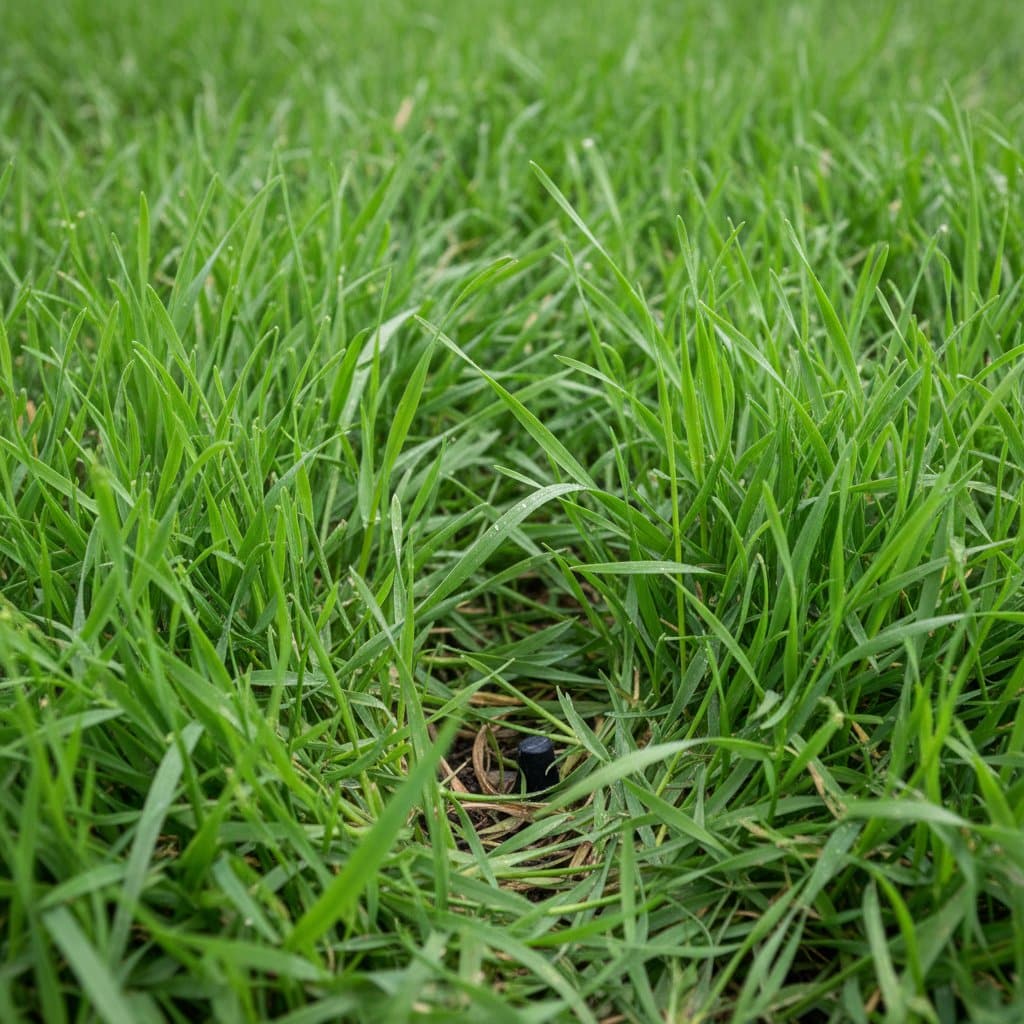
Even when a donut isn’t fully sunken, grass is persistent. Bermuda and St. Augustine in particular can send runners across a concrete donut within a few weeks. Once the blades overhang the ring, the mower clips the head anyway — the donut just delays the inevitable.
If you’ve ever found a sprinkler head completely hidden under a mat of lawn, this is usually why. The old solution (a concrete donut) is buried right there with it.
After replacing my 10th sprinkler head, I started looking more carefully at the ones that had “protection” around them. Half the concrete donuts were sunken, half had grass growing right over them. I wasn’t solving the problem — I was just buying time.
Concrete Cracks, Especially in Freeze-Thaw Climates
Concrete absorbs water. When temperatures drop, that water expands. Even in the Southeast, a hard freeze can crack a concrete donut. Once cracked, the pieces shift and the donut no longer holds its shape around the head. You’re back to an unprotected head, except now there’s broken concrete to clean up.
As SprinklerBuddy notes, concrete donuts “break easily in cold climates when frozen” — and even mild winters in Florida or Georgia can push them past their limits.
They Look Rough Over Time
This is more of a quality-of-life issue, but concrete donuts chip, stain, and collect debris. In a well-kept lawn, they look out of place. Some homeowners paint them to blend in; most don’t bother after the novelty wears off.
How Different Sprinkler Protection Methods Compare
Not all options are equal. Here’s an honest side-by-side.
| Method | Grass growth inhibition | Sinking resistance | Mower impact resistance | What fails first |
|---|---|---|---|---|
| Concrete donut | Partial at first | Poor — sinks within 1-2 seasons | Fair — breaks in cold | Sinking and grass overgrowth |
| Rubber/plastic generic ring | Poor | Poor | Fair | Deforms, rides up, gets buried |
| PVC pipe DIY | None | OK | Poor — can crack | Grass ignores it entirely |
| Sprinkler-Guard by GRASSHOLE | Yes — inhibits grass at the base | Good — flexible ABS sits at grade | Yes — absorbs flex instead of snapping | One guard at a time if it takes a hit |
The concrete donut gets you partial protection for one season. A flexible ABS guard designed to sit at ground level and inhibit grass from the start is a different category of solution.
The Cost Math Over Time
Concrete donuts look cheap at the shelf. Run the numbers over a few years and the picture changes.
| Cost item | Year 1 | 5-Year total |
|---|---|---|
| Concrete donuts (set of 10, replace every 2 seasons) | Low upfront, replace again in 2 seasons | Ongoing replacement cost every other year |
| Sprinkler-Guard 10-pack (one-time) | $64.99 | $64.99 |
| One service call for a broken head (avoided) | $0 | $130-$360 saved |
The guard set costs a little more upfront than a bag of concrete donuts. But you’re not replacing them every other season, and you’re stopping the service calls that add up fast. According to LawnStarter and Angi, the average homeowner spends $130 to $360 on sprinkler system repairs per call. One avoided service call pays for the guards.
What Actually Works Better
The Sprinkler-Guard by GRASSHOLE is a different design from the start. It’s a flexible disc — made from Flexible Advance ABS with UV Deterrent — that installs around the base of a pop-up head in about 30 seconds with no tools.
Unlike a concrete donut, it sits flat and flexible at ground level. When the mower deck or trimmer catches it, the material flexes instead of cracking. Grass roots can’t drive it into the soil the way they can pull a heavy concrete ring down. The ring design around the head inhibits grass from encroaching at the base — the problem that concrete donuts only partially address.
It fits any sprinkler head up to 3 inches, comes in packs from 10 to 60, and ships free on orders over $100.
For larger pop-up heads and rotors — heads wider than 3 inches — there’s a 5-inch version in multiple pack sizes as well. If you have a mix of spray heads and rotors in the same yard, you can get both sizes and cover everything.
You can check out the full lineup at Sprinkler-Guard.com or read through the best sprinkler head protectors comparison to see how the options stack up.
How to Install a Sprinkler Head Guard (Step-by-Step)
Total time needed: about 10 minutes.
- Step 1: Locate the head and clear the area
Find the head. If it's already buried in grass, use your finger or a small hand rake to clear the blades away from the base. You want to see the housing clearly.
- Step 2: Press the guard into position
Set the Sprinkler-Guard ring over the head. The center opening fits around the head body; the disc sits flat against the turf. Press it down gently so it's flush with the grass surface. It doesn't need to be dug in — just seated.
- Step 3: Fill the center if desired
Some homeowners add a handful of pea gravel or small stones around the head inside the ring. This keeps the immediate area from getting muddy after irrigation and makes the head easy to see. Completely optional.
- Step 4: Run the zone and check
Turn on the irrigation zone. The head should pop up through the center opening without interference. Check that the spray pattern is unobstructed and the guard isn't sitting too high. If it is, press it down a bit more.
- Step 5: Confirm fit after first mow
After your first mow over the protected heads, walk the yard and look for any guards that got shifted. First mow they sometimes move a bit. Press them back flush and they usually stay after that. If you want to see this in more detail, the [how to protect sprinkler heads from lawn mowers](https://grassholesystem.com/protect-sprinkler-heads-lawn-mowers/) post walks through mowing-specific tips alongside the guard install.
Frequently Asked Questions
**A sprinkler donut is a ring-shaped ring** — usually concrete, rubber, or plastic — that fits around the base of a pop-up sprinkler head to buffer it from mower contact and slow grass encroachment. The concrete version is the traditional choice; flexible plastic versions (like the Sprinkler-Guard) are a more recent and longer-lasting alternative.
**They work partially, then lose effectiveness.** Concrete donuts provide some mower protection when new, but they tend to sink into the soil within one to two seasons, especially in warm climates with active grass growth. Once sunken, grass reclaims the area and the protection disappears. Flexible plastic alternatives stay flush longer and inhibit grass more effectively.
**No — flexible plastic guards generally outperform concrete donuts** over time. Concrete is heavy and sinks; it also cracks in cold weather. A flexible ABS guard like the Sprinkler-Guard sits at grade, flexes under mower contact instead of cracking, and actively inhibits grass at the base. The head-to-head comparison is covered in detail in the [concrete donuts vs. Sprinkler Guard](https://grassholesystem.com/concrete-donuts-vs-sprinkler-guard/) post.
**The donut sinks first, then the head follows.** Concrete absorbs water and gets pulled down by soil compression and root action. Once the donut is below grade, it stops holding the head in position. The head then sinks on its own. A lighter-weight guard that doesn't rely on mass to stay put — and doesn't hold water — is less susceptible to this cycle. More on the sinking problem in the [sprinkler heads keep sinking](https://grassholesystem.com/sprinkler-heads-keep-sinking/) post.
**One per head.** Count your pop-up heads per zone and buy accordingly. Most residential yards with a standard 4-zone system have between 15 and 30 heads. The 20-pack at $125 covers most yards well; the 30-pack at $180 makes sense if you have more than 25 heads or want extras on hand.
**No.** The guard fits around the base of the head, not over the nozzle. When the system runs, the head pops up through the center opening of the guard and sprays normally. Coverage pattern, radius, and arc are unchanged. The only thing the guard affects is what happens to the head when the mower comes through.
**Yes — significantly.** According to [EPA WaterSense](https://www.epa.gov/watersense/sprinkler-spruce-up), a single broken sprinkler head can waste up to 25,000 gallons of water per year. A cracked housing or tilted head that sprays sideways instead of up is running your water bill the entire time the zone is active. Fixing — or better, preventing — head damage pays back in water savings, not just repair bills.
The Bottom Line
Concrete sprinkler donuts are a familiar fix that works for a season before the lawn reclaims the ground. They sink, they crack, and grass grows right over them while you’re not watching. If you’ve already been through that cycle, you know what I mean.
A flexible guard that sits flush, absorbs impact instead of shattering, and physically inhibits grass from the base is a more durable answer to the same problem. The Sprinkler-Guard 20-pack covers most yards and ships free on orders over $100.
Put them in once, mow normally, and stop scheduling service calls for broken heads.
Not sure? The Sprinkler-Guard ships in 10/20/30/60-packs. If one ever takes too much abuse, you swap just that one in 30 seconds — no full system to replace.
Shop Sprinkler-Guard
- Starting at $64.99 for a 10-pack
- Free shipping on orders over $100
- 500+ five-star ratings from homeowners on Amazon
- Made in the USA by a Veteran-Owned Business in Bradenton, Florida
- Patented design — featured by Kevin Harrington (from Shark Tank)
- No tools required — installs in 30 seconds per head
- One-by-one swap design — if a guard takes too much abuse, swap just that one
Last updated: September 2026. Statistics sourced from EPA WaterSense, Johns Hopkins Medicine, LawnStarter, LawnLove, HomeGuide, IBISWorld. Product specifications and pricing current as of publication date.