A sprinkler head grass cutter drill attachment cuts a ring around pop-up heads so the mower clears them. Here’s how it works, its limits, and the fix that lasts.
⏱ 10 min read · Last updated September 2026
Ken Kwiatkowski
Founder of GRASSHOLE Corporation & inventor of the Sprinkler-Guard
Veteran. Florida homeowner who got tired of replacing the same broken sprinkler heads every season. Featured by Kevin Harrington (from Shark Tank). Recipient of the JMI 30 Award. Manufactures in Bradenton, Florida.
Full disclosure: GRASSHOLE Corporation manufactures the Sprinkler-Guard discussed in this guide. Our recommendations come from years of field testing and customer feedback.
Table of Contents
- Why Grass Keeps Taking Over Your Sprinkler Heads
- What Is a Sprinkler Head Grass Cutter Drill Attachment?
- Step-by-Step: Using a Sprinkler Head Grass Cutter Attachment
- Why the Drill Attachment Keeps You on a Treadmill
- The Fix That Actually Breaks the Cycle
- Drill Attachment vs. Sprinkler-Guard: How They Compare
- The Bottom Line
A sprinkler head grass cutter drill attachment is a circular edging bit that mounts on any standard drill and cuts a ring of sod around your pop-up heads, creating a clear zone so the mower deck passes over without contact. It works for a few weeks. The grass grows back. A physical guard around each head stops the cycle for good without any repeat cutting.
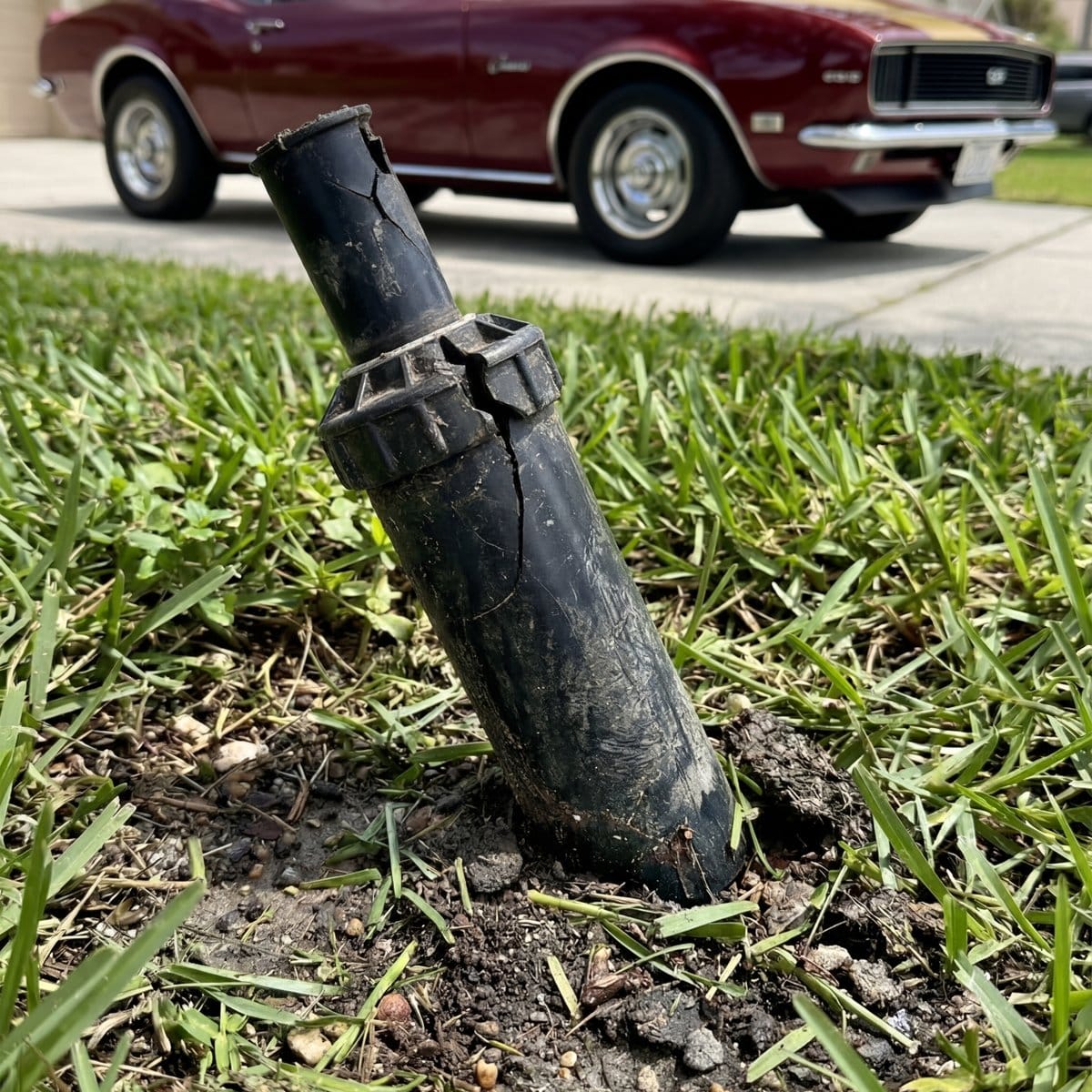
If you have grass creeping over your sprinkler heads, you know what happens at mowing time. You swerve around the spots where you think the heads are, and at some point you hear that crunch when the mower clips one anyway. Then you’re looking at a $59 to $150 service call just for the head replacement, per LawnLove, and that’s before they charge you the visit fee on top.
The drill attachment approach is something a lot of homeowners find on YouTube. Cut a clean ring around each head, the mower clears it easily, no more clipping. It’s a smart idea. The question is how it holds up after a few mowing cycles.
Why Grass Keeps Taking Over Your Sprinkler Heads
Pop-up sprinkler heads sit flush with the ground when the system is off. That’s exactly where turf wants to be. In the Sun Belt, Bermuda and St. Augustine spread by surface runners called stolons, and they don’t stop just because there’s a small plastic cylinder in the way. Within a few weeks of any cut, those runners creep right back over and around the head.
That coverage does a few things. It buries the head so you can’t see it when you’re mowing. The grass roots and stems compress around the riser, which makes the head stick or stop popping up cleanly. Then when the mower comes through, the head is already half hidden, already partially stuck, and you don’t even see it coming before you hit it.
According to irrigation professionals at Texas Rainmakers, lawn mowers are the number one cause of broken and cracked sprinkler heads across the board. This isn’t a rare event. It’s a routine problem for any homeowner with an irrigation system and an active mowing schedule.
A single damaged head can waste up to 25,000 gallons of water per year, per the EPA. For something you can prevent for a few dollars per head, that’s a lot of water going sideways in your yard.
Why Bermuda and St. Augustine spread fastest around heads
Both grasses are the dominant turf types across Florida, Georgia, the Carolinas, and Texas, and both spread aggressively by stolons. Give them a bare patch of soil, like the disturbed area around a sprinkler head, and they fill it in within weeks. That’s great for lawn coverage in general. It’s not great when the bare patch is supposed to stay bare.
The other thing these grasses do is build thatch. Over time, the compressed thatch layer around a pop-up head is what causes it to sink. The roots and dead material pile up, and the head gets pushed or pulled lower relative to the soil surface. Once that starts, the grass covers it faster, and the mower risk goes up. See more on why this happens in our article on why sprinkler heads keep sinking.
What Is a Sprinkler Head Grass Cutter Drill Attachment?
A sprinkler head grass cutter drill attachment is a specialty edging bit, usually circular or cup-shaped, that connects to a standard cordless drill. You position it over the sprinkler head and drive it into the ground in a rotating motion, cutting a ring of sod away from the head. The cleared zone is typically 6 to 8 inches wide, enough for the mower deck to pass over the head without making contact.
There are a few different designs available. Some use a rotary cutting motion similar to a hole saw for turf. Others use a spade-style action where you push and turn by hand, with the drill doing the rotation. Most fit a quarter-inch or half-inch chuck and work with any standard cordless drill you already own.
The tool itself typically costs between $20 and $40. It takes one to two minutes per head on the first pass. And it does work, for a few weeks.
Step-by-Step: Using a Sprinkler Head Grass Cutter Attachment
Total time needed: about 6 minutes.
- Step 1: Mark every head in your yard before you pick up the drill
Walk the full system with marking spray or small flags before you cut anything. Pop each zone on manually, note where every head is, and flag it. Trying to guess based on memory is how heads get nicked by the bit itself. Know where each one is before the drill comes out.
- Step 2: Set your depth and cut the ring slowly
Adjust your bit depth so you're cutting through the grass root zone but not punching into the supply line or riser fitting below. Two to three inches is usually the right target for most residential turf. Work the drill in a full circle, slow and steady. Don't force the bit straight down. The rotation does the cutting; you just guide the circle.
- Step 3: Clear the cut grass and test each head
Pull the sod ring out and knock any loose debris away from the head. Then manually press the head down and release it to check that it pops back up freely. If it sticks, there's root intrusion into the riser that needs clearing before you mow. If any head feels off-center after cutting, press it back into alignment before the next watering cycle. For issues with heads that won't retract or are already buried too deep, take a look at how other homeowners handle [grass growing over their sprinkler heads](https://grassholesystem.com/stop-grass-growing-over-sprinkler-heads/) for the full walkthrough.
Why the Drill Attachment Keeps You on a Treadmill
Here’s the thing the YouTube videos don’t always make clear: the drill attachment cuts the grass, but it does not stop the grass from coming back. Bermuda re-establishes in a cleared ring in three to four weeks during summer. St. Augustine takes a little longer but gets there. You’re going to be doing this three to six times per mowing season, every year.
There is also the mower impact problem. The cleared ring creates clearance from the mower deck, but if you’re even slightly off your mowing line, or if a wheel drops into the ring, the head still takes a hit. The drill attachment solves the grass overgrowth problem, not the mechanical impact problem. They’re related but separate issues.
Every time you use the bit, there’s also a small risk of bumping the head itself. A riser pushed even slightly out of alignment by the bit can start throwing water sideways at the next watering. You fixed one problem and created another.
The drill attachment is like edging around your driveway. It looks great for a few weeks, then you’re doing it again. A guard around each head is more like sealing the concrete. You do it once and the problem stops.
The average homeowner with a sprinkler system spends $130 to $360 per repair call, per LawnStarter and Angi. If the drill attachment routine slips once and a head gets clipped, you’re back in that range fast. The repeat maintenance cycle carries real risk every single time.
The Fix That Actually Breaks the Cycle
If you want to stop resetting this every season, the answer is a physical barrier around each head. The Sprinkler-Guard by GRASSHOLE is a round guard made from Flexible Advance ABS with UV Deterrent that installs in about 30 seconds, no tools needed. You press it into the soil around the head, and that’s it.
The guard sits flat at ground level with a 7-inch outer diameter and a 3.5-inch inner opening that fits any standard pop-up head up to 3 inches. The mower rides right over the flange without reaching the head. The ABS material absorbs trimmer and mower contact instead of transferring the impact straight to the head. And the physical ring structure keeps grass from creeping inward the way it creeps over bare soil.
Most homeowners put one around every head in their yard. At $6.25 per head in a 20-pack, it’s less than the cost of a single service call just to have someone show up and assess the damage. You can see the current pricing at Sprinkler-Guard.com.
For the full breakdown of how guards protect heads from all forms of mowing damage, see our detailed guide on protecting sprinkler heads from lawn mowers.
Drill Attachment vs. Sprinkler-Guard: How They Compare
| Drill Attachment | Sprinkler-Guard | |
|---|---|---|
| Upfront cost | $20-$40 for the tool | $6.25/head (20-pack) |
| Time per head | 2-3 minutes | 30 seconds |
| Grass regrowth | Returns in weeks | Inhibited by physical barrier |
| Protects from mower impact | No | Yes, ABS absorbs contact |
| Fits standard pop-ups up to 3″ | Most | Yes |
| Needs to be repeated | Yes, every season | No |
| Approach | 1 Head, Year 1 | 1 Head, 5 Years |
|---|---|---|
| Drill attachment + your time | ~$20 tool + 3 min/head, 4-6x/year | $20 tool + 4-6 hours total labor |
| Pro replacement after damage | $59-$150 | $295-$750 |
| Sprinkler-Guard (20-pack rate) | $6.25 one time | $6.25 total |
The numbers are hard to argue with. The guard costs less than a single repair call covers one head for good, while the drill attachment keeps you in a maintenance loop that carries real damage risk every time you do it.
Frequently Asked Questions
**It cuts a circular ring of sod** around a pop-up sprinkler head to create a clear zone so the mower deck passes over without clipping the head. You attach the bit to a standard cordless drill, position it over the head, and cut in a rotating motion. It takes one to two minutes per head and works well on the first pass. Grass grows back within a few weeks in warm climates.
No. Most sprinkler head grass cutter bits fit a quarter-inch or half-inch chuck, which is standard on any cordless drill. You don't need a heavy-duty drill. A drill with a charged battery and a clutch setting helps since you're making repeated small cuts, not driving fasteners.
In Bermuda grass, plan on re-cutting every three to four weeks during summer growing season. St. Augustine fills back in a bit more slowly but still returns within four to six weeks. In most Sun Belt climates, that means three to six cuttings per year, every year you use this approach.
Not directly. Creating a cleared ring helps the mower deck avoid the head on a clean mowing pass. But if you drift slightly off your line, or if the mower deck drops into the cleared ring while turning, the head still takes a hit. A physical guard absorbs that contact; a cleared ring of soil does not.
Most homes with in-ground irrigation systems have between 15 and 30 pop-up heads. Larger properties or multi-zone systems run higher. If you're switching from the drill attachment cycle to guards, most homeowners cover the full yard with a [20-pack or 30-pack](https://sprinkler-guard.com) in one order.
A physical guard is the most reliable approach for stopping the regrowth cycle. Some homeowners also add a thin layer of pea gravel inside the guard ring after installation, which creates an additional barrier that grass stolons have trouble crossing. The combination of the guard flange and a light gravel fill is about as low-maintenance as it gets for a residential sprinkler system.
Yes. The standard Sprinkler-Guard fits any pop-up head up to 3 inches wide, which covers most Rain Bird 1800 series, Hunter Pro series spray heads, and comparable brands. For larger rotor heads like the Rain Bird 5000 or Hunter PGP, the 5-Inch Sprinkler-Guard is the right fit. Check the width of your head before ordering if you have a mix of spray and rotor heads on the same system.
The Bottom Line
A sprinkler head grass cutter drill attachment is a real tool that solves a real problem. If you need to clear grass quickly before mowing season and don’t want to deal with the problem long-term, it works for that. Just know you’ll be doing it again in a few weeks, and every time you run that bit near a head, there’s some risk.
The Sprinkler-Guard handles both the grass buildup and the mower impact in one 30-second install per head. At $6.25 per head from a 20-pack, you’re spending less than a single repair visit costs just to have someone show up.
If you’re ready to get off the treadmill, check the full line at Sprinkler-Guard.com and see what fits your system.
Not sure? The Sprinkler-Guard ships in 10/20/30/60-packs. If one ever takes too much abuse, you swap just that one in 30 seconds — no full system to replace.
Shop Sprinkler-Guard
- Starting at $64.99 for a 10-pack
- Free shipping on orders over $100
- 500+ five-star ratings from homeowners on Amazon
- Made in the USA by a Veteran-Owned Business in Bradenton, Florida
- Patented design — featured by Kevin Harrington (from Shark Tank)
- No tools required — installs in 30 seconds per head
- One-by-one swap design — if a guard takes too much abuse, swap just that one
Last updated: September 2026. Statistics sourced from EPA WaterSense, Johns Hopkins Medicine, LawnStarter, LawnLove, HomeGuide, IBISWorld. Product specifications and pricing current as of publication date.