Watering in peak summer heat wastes 30-60% of irrigation water to evaporation and triggers fungal disease overnight. Learn the right window and best times to run sprinklers.
⏱ 8 min read · Last updated November 2026
Ken Kwiatkowski
Founder of GRASSHOLE Corporation & inventor of the Sprinkler-Guard
Veteran. Florida homeowner who got tired of replacing the same broken sprinkler heads every season. Featured by Kevin Harrington (from Shark Tank). Recipient of the JMI 30 Award. Manufactures in Bradenton, Florida.
Full disclosure: GRASSHOLE Corporation manufactures the Sprinkler-Guard discussed in this guide. Our recommendations come from years of field testing and customer feedback.
Table of Contents
Grass doesn’t burn from afternoon irrigation — that’s a myth. The real problems are evaporation, fungal disease risk overnight, and water restriction windows. Watering in peak summer heat wastes 30-60% of irrigation water before it reaches the roots. Shift your schedule to before 10 a.m. and you sidestep all three problems at once.
You’ve probably heard it: don’t water your lawn during the heat of the day or you’ll scorch the blades.
It’s been repeated so often most homeowners treat it as fact. The problem is it isn’t true — at least not the way it’s usually explained. Water droplets on grass blades don’t cause burn marks in direct sunlight. University extension programs have debunked that one repeatedly over the past decade.
But the advice to avoid midday irrigation is still good advice. The people saying it are just wrong about why. The actual reasons to keep your sprinklers off during the hottest part of the day are more practical — and more expensive to ignore — than anything to do with leaf scorch.
According to EPA WaterSense, landscape irrigation accounts for nearly one-third of all residential water use nationwide. When you’re running your system in the middle of the day, a meaningful chunk of that water never makes it to the turf.
Why “Too Hot to Water” Gets the Conclusion Right for the Wrong Reasons
The leaf burn myth traces to a 2010 study suggesting water droplets could act as lenses and focus sunlight. But the conditions required were laboratory-specific — distilled water, perfect spherical geometry, a specific sun angle — none of which describe real lawn irrigation. Spray heads throw irregular droplets that evaporate in seconds on a 95-degree afternoon. There’s no burn happening.
So grass blades don’t scorch from afternoon irrigation. But your irrigation efficiency does.
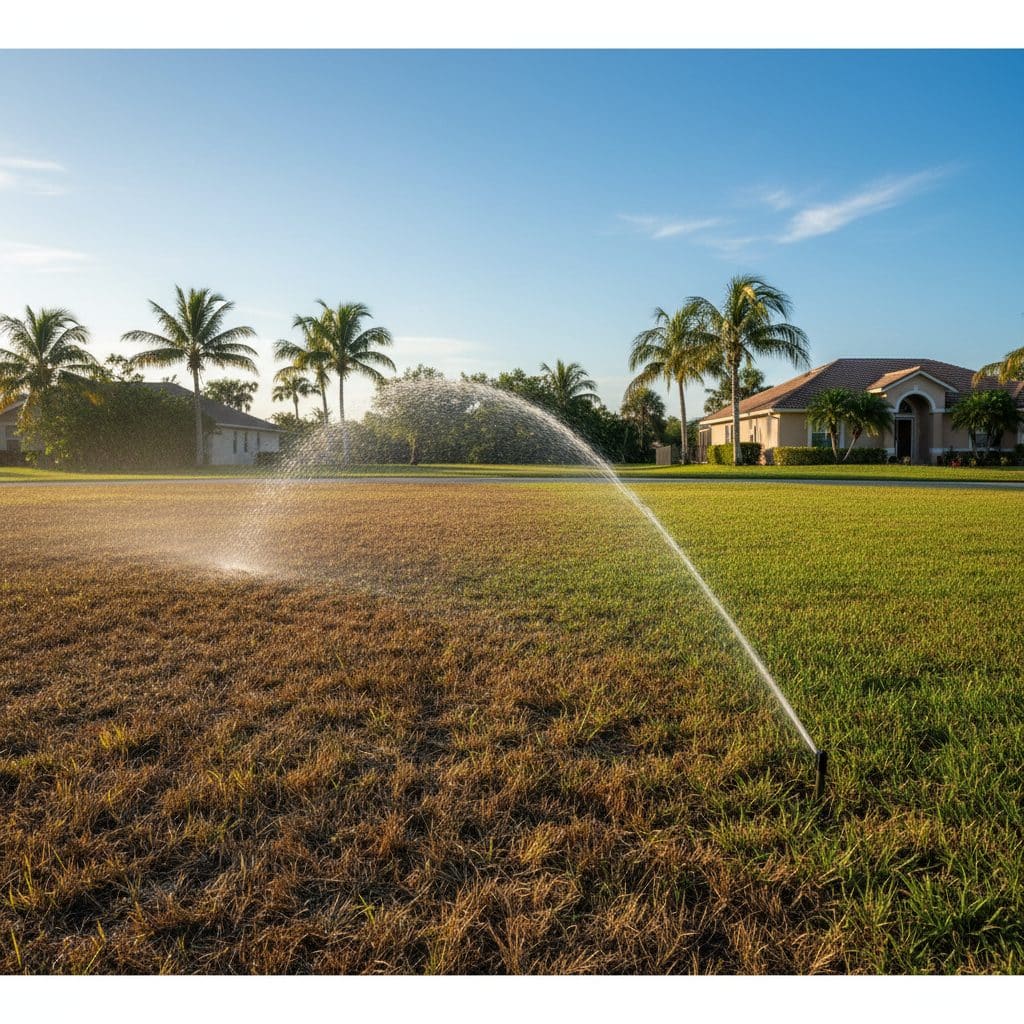
Here’s what actually happens when you run your sprinklers at 2 p.m. in August in the Sun Belt.
The 4 Real Problems with Watering When It’s Scorching Outside
1. Rapid evaporation wastes a large share of every zone
When air temperature sits above 90 degrees and relative humidity drops, sprinkler water evaporates before it reaches the soil surface, per University of Florida IFAS Extension. On a peak summer afternoon, you can lose 30-60% of your irrigation water to the air before the grass ever sees it — right in line with GreenSpaces Coalition’s national estimate for residential irrigation waste.
If you’re running 20-minute spray zones expecting to saturate the root zone, you may only be delivering 12-14 effective minutes worth of moisture to the turf.
2. Afternoon irrigation promotes fungal disease overnight
When you water at 3 or 4 p.m., grass blades stay wet going into the evening as temperatures drop. Warm, wet turf in the dark is the ideal condition for dollar spot, brown patch, and gray leaf spot — the three most common fungal diseases on Sun Belt lawns. Your turf needs time to dry before nightfall.
Early morning watering solves this completely. Water evaporates off the blades during the day, roots absorb the moisture, and fungal risk stays low.
3. Many Sun Belt counties hit their restriction windows at midday
Florida water management districts, along with water authorities across Georgia, Texas, and the Carolinas, ban or restrict irrigation between 10 a.m. and 4 p.m. during summer months per LawnLove’s Florida restrictions guide. Running your system during restriction hours isn’t just wasteful — it can earn a warning notice or fine on the first offense in many counties.
If you’re in Florida and wondering whether afternoon irrigation is restricted, assume yes. Check your county’s water management district site to confirm.
4. Heat stress compounds wear on unprotected sprinkler heads
Running sprinkler heads during peak heat hours doesn’t ruin them on the first run. But unprotected heads sitting in bare soil absorb significant thermal stress from both direct sun and radiant ground heat, especially near concrete edges and driveways. Over a season, that contributes to seal degradation and early cap cracking.
A guard around each head reduces that radiated heat exposure and gives the cap physical protection from mower contact year-round.
The best watering window is 4 a.m. to 10 a.m. Early morning delivers water when evaporation is lowest, leaves dry out fully before nightfall, and most Sun Belt restriction windows are open. It’s the one schedule change that solves three problems at once.
What the Actual Temperature Threshold Looks Like
Per University of Florida IFAS Extension, Bermuda and St. Augustine grasses actively absorb irrigation water most efficiently when soil temperatures are between 65 and 85 degrees Fahrenheit. When air temperatures consistently exceed 90 degrees — standard from June through September across the Sun Belt — the limiting factor shifts from root uptake to efficient delivery.
The table below shows what each watering window typically looks like during a Sun Belt summer (approximate temperature ranges based on IFAS summer irrigation guidance):
| Watering window | Air temp range | Evaporation risk | Fungal risk | Restriction status |
|---|---|---|---|---|
| 4 a.m. to 10 a.m. | 72-82 degrees | Low | Low (blades dry by noon) | Open in most districts |
| 10 a.m. to noon | 83-90 degrees | Medium | Low | Restricted in many counties |
| Noon to 4 p.m. | 88-98 degrees | High | Medium | Restricted in most Sun Belt |
| 4 p.m. to 7 p.m. | 84-92 degrees | Medium | High (wet into night) | Open but high fungal risk |
| After 7 p.m. | 75-82 degrees | Low | Very high | Open, but avoid |
How to Fix Your Summer Watering Schedule
Total time needed: about 6 minutes.
- Step 1: Move your start time to between 4 a.m. and 8 a.m.
This is the single highest-impact change you can make. Set your controller's start time to 5 or 6 a.m. if you need to give yourself a buffer before any timed zones run over. If you have many zones and they can't all complete before 10 a.m., prioritize turf zones early and push ornamental beds later — grass is more heat-sensitive than most shrubs.
- Step 2: Adjust run times for summer efficiency
In peak summer heat, you need longer run times per zone to account for the evaporation you're preventing by watering early. A 20-minute spray zone that delivered adequate moisture in April may need to run 22-25 minutes in July because ground temperature is higher and the turf is under more stress. Set your run times for the outcome (soil saturated to the root zone) rather than the clock.
- Step 3: Walk the yard after each zone and look for broken heads
Per Resource Central, a single broken sprinkler head can waste 9 to 16 gallons of water per minute — up to 25,000 gallons per year if left uncorrected. After adjusting your schedule, do a quick zone-by-zone walk: heads spraying sideways, heads not popping up, heads shooting straight up past the cap — all are signs of damaged seals or cracked caps that need replacement. Once a head is replaced, a Sprinkler-Guard around the cap prevents the next mower strike from restarting the cycle. Made from Flexible Advance ABS with UV Deterrent, it absorbs deck contact and inhibits grass from crowding the retraction seal. The 20-pack at Sprinkler-Guard.com covers most mid-size residential yards — homes with 15 to 30 heads can protect them all in one order from the 3-inch shop page.
What Poor Timing Costs Over Time
| What bad habits cost you | 1 season | 5 seasons |
|---|---|---|
| Water lost to evaporation | 30-60% of outdoor water use gone | Same inefficiency every year |
| Sprinkler repair calls from accelerated head wear | $130 to $360 per season | $650 to $1,800 total |
| Water wasted from one undetected broken head | Up to 25,000 gallons | 125,000 gallons |
Source: evaporation range per GreenSpaces Coalition / EPA; repair costs per LawnStarter and Angi; broken-head waste per EPA WaterSense.
Frequently Asked Questions
No. This myth traces to a 2010 laboratory study, but real lawn irrigation doesn't replicate the precise conditions that study required. Grass blades don't scorch from sprinkler water in direct sun. The real reasons to avoid afternoon irrigation are evaporation loss, overnight fungal risk, and water restriction windows — not leaf scorch.
Most extension programs treat 90 degrees Fahrenheit as the practical threshold where evaporation loss becomes significant enough to change your approach. Above 90 degrees, you may lose 30-60% of your irrigation water before it reaches the soil, per GreenSpaces Coalition. At that point, shift to the 4-10 a.m. window where evaporation is minimal and the water actually gets to the roots.
Nighttime evaporation is low, which sounds like a win. But leaving grass wet overnight in a warm, humid climate is the fastest route to dollar spot, brown patch, and gray leaf spot. Early morning is the right answer for the Sun Belt — not night. For more on timing, see our full breakdown on the best time to water your lawn.
More frequent watering during a heat wave can make sense if the lawn is showing visible stress — rolled or folded blades during the day are a sign. But established Bermuda and St. Augustine grass go slightly semi-dormant in extreme heat and recover once temperatures drop. Increasing frequency without increasing the early-morning start time won't help much. Get the timing right first, then adjust frequency if stress signs persist.
For established lawns, yes. Twice-daily irrigation encourages shallow root systems that are more vulnerable to summer stress and drought. The target is infrequent, deep watering that pushes roots down where soil temperature is more stable. For the full breakdown on frequency, see our should I water my lawn twice a day guide.
Yes. Bermuda is more heat and drought tolerant than St. Augustine. Bermuda can handle brief drought and will bounce back faster if a scheduled watering cycle is missed. St. Augustine needs more consistent moisture and shows heat stress sooner. Both perform best with early-morning irrigation during summer — the timing difference is less important than the grass type difference in how quickly you'll see stress symptoms.
Change it. Most irrigation controllers take five minutes to update the start time — check your manual or the manufacturer's app. Moving from a 2 p.m. run to a 6 a.m. run is one of the highest-return changes a Sun Belt homeowner can make to their irrigation system. You'll see the difference in turf quality and water usage within two weeks.
The Bottom Line
Water early in the morning. Not because afternoon irrigation burns the grass — it doesn’t — but because early morning is when evaporation is lowest, restriction windows are open, and your turf dries out fully before nightfall.
On a 95-degree afternoon, you may lose half your sprinkler water to the air before it reaches the root zone. At 6 a.m. on the same day, most of it gets in. Same water bill, completely different result.
If you’re already watering at the right time but still losing heads to mower contact or grass burial, that’s a separate problem with a simple fix before the next mowing. The full guide on protecting sprinkler heads from lawn mowers walks through the same approach: prevent the damage before it happens rather than replacing heads after.
Not sure? The Sprinkler-Guard ships in 10/20/30/60-packs. If one ever takes too much abuse, you swap just that one in 30 seconds — no full system to replace.
Shop Sprinkler-Guard
- Starting at $64.99 for a 10-pack
- Free shipping on orders over $100
- 500+ five-star ratings from homeowners on Amazon
- Made in the USA by a Veteran-Owned Business in Bradenton, Florida
- Patented design — featured by Kevin Harrington (from Shark Tank)
- No tools required — installs in 30 seconds per head
- One-by-one swap design — if a guard takes too much abuse, swap just that one
Last updated: November 2026. Statistics sourced from EPA WaterSense, Johns Hopkins Medicine, LawnStarter, LawnLove, HomeGuide, IBISWorld. Product specifications and pricing current as of publication date.