



Learn why seasonal temperature swings around sprinkler heads cause irrigation failure and how stabilizing sprinkler heads supports watering
There’s a rhythm to the seasons that every lawn must endure.
Warm afternoons give way to cool evenings. Moist soil dries under summer heat. Autumn mornings settle into crisp air. And with each shift in temperature, the ground beneath your lawn subtly expands and contracts.
Most of this movement goes unnoticed — until something begins to drift.
If you’ve ever wondered why seasonal temperature swings around sprinkler heads cause gradual irrigation failure, the answer lies not in the sprinkler itself, but in the soil’s quiet reaction to temperature change.
As Angus McGrass might say, scanning the turf after a brisk morning chill, “The land breathes with the weather, aye — and what breathes will move.”
Let’s explore why seasonal temperature swings around sprinkler heads cause gradual irrigation failure and what that means for long-term turf health.
Soil expands when moisture is present and contracts as it dries. Temperature shifts accelerate this process.
During warmer months, soil softens and loosens slightly. During cooler periods, it firms and contracts. These repeated cycles cause subtle structural movement around sprinkler heads.
When seasonal temperature swings around sprinkler heads cause gradual irrigation failure, the sprinkler head may not crack or visibly break. Instead, it slowly shifts in elevation or angle.
Even a minor adjustment in position can affect spray distance and arc.
Sprinkler heads depend on stable footing to distribute water evenly. Temperature-driven soil movement undermines that stability.
Expansion and contraction cycles occur repeatedly throughout the year.
As temperatures fluctuate:
When seasonal temperature swings around sprinkler heads cause gradual irrigation failure, these cycles gradually loosen soil support on one side of the sprinkler housing.
Over time, the sprinkler head may tilt slightly or sink unevenly.
The change is incremental, but irrigation precision depends on consistency.
This is why some lawns appear healthy in one season and inconsistent in another — the underlying support has shifted.
Seasonal shifts also influence surface pressure.
In warmer months, softened soil is more susceptible to foot traffic and mower compression. In cooler months, firmer soil resists movement but may settle differently once temperatures rise again.
When seasonal temperature swings around sprinkler heads cause gradual irrigation failure, surface activity compounds subsurface movement.
A sprinkler head that appears level in spring may sit slightly lower by late summer.
A small depression can shorten spray reach. A slight lean can redirect water away from critical turf areas.
The lawn’s response is rarely immediate — but over time, dry patches emerge.
When seasonal temperature swings around sprinkler heads cause gradual irrigation failure, irrigation efficiency declines.
Homeowners may extend watering times to compensate for thinning areas. This increases water usage and can lead to runoff or oversaturation in stable zones.
Balanced irrigation depends on consistent sprinkler head alignment.
Environmental responsibility in lawn care requires anticipating soil movement rather than reacting to turf symptoms.
Stability reduces waste.
Imagine a sprinkler head located in a sunny portion of the lawn.
During hot months, soil dries and contracts slightly around the head. As cooler weather returns and moisture increases, the soil expands unevenly.
Over several seasons, the head settles lower on one side.
The spray arc begins to fall short of a narrow strip near a walkway. The strip fades gradually.
The homeowner increases watering duration, but the imbalance persists.
After stabilizing the soil evenly around the sprinkler head, temperature-driven expansion and contraction cycles no longer alter alignment significantly.
The spray arc returns to full reach. The narrow strip regains density without increasing watering time.
The improvement came from structural stabilization, not schedule changes.
Understanding why seasonal temperature swings around sprinkler heads cause gradual irrigation failure shifts focus toward preventative reinforcement.
This is where Sprinkler-Guard by Grasshole integrates naturally into a thoughtful irrigation strategy.
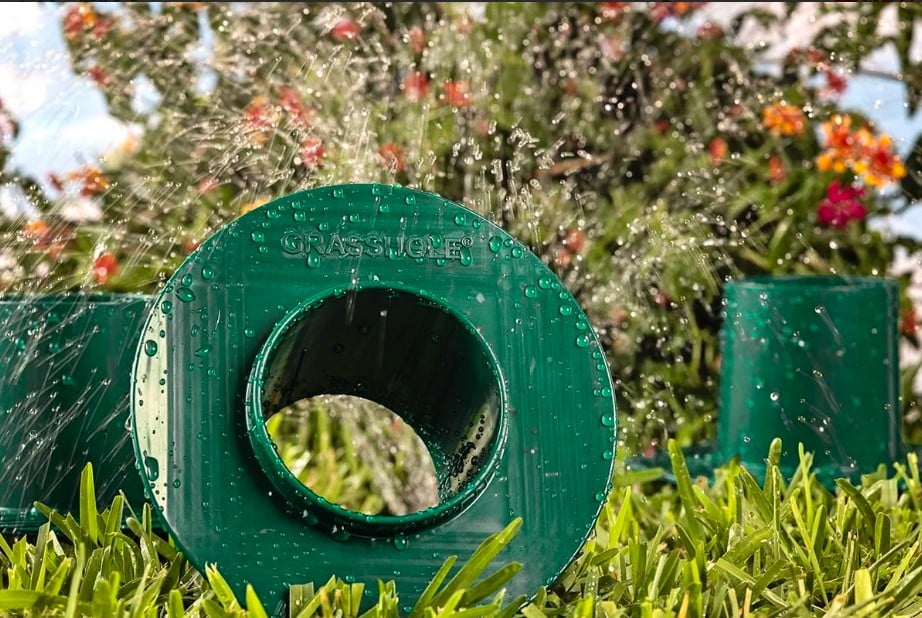
Sprinkler-Guard by Grasshole is designed as a preventative solution for sprinkler head damage and alignment issues. Made from advanced flexible ABS plastic, it adapts to soil movement rather than cracking under pressure.
When seasonal temperature swings around sprinkler heads cause gradual irrigation failure due to soil expansion and contraction, adaptive protection helps distribute pressure evenly and maintain stable elevation.
It helps inhibit grass growth and reduces sinking that contributes to misalignment.
It is not a seasonal fix. It is structural support that works year-round as part of a comprehensive irrigation plan.
By maintaining consistent head alignment through seasonal shifts, sprinkler heads deliver intended spray arcs. Intended spray arcs support balanced soil moisture and resilient turf performance.
Built super tough and made in the USA, it reinforces long-term irrigation efficiency.
Soil expands and contracts as temperatures and moisture levels change. These cycles gradually alter soil structure around sprinkler heads.
Repeated expansion and contraction can cause slight tilting or sinking. Even minor shifts alter spray arcs and reduce irrigation consistency.
Natural soil movement cannot be eliminated, but structural stabilization can minimize its impact on sprinkler alignment.
Yes. Adaptive protection like Sprinkler-Guard by Grasshole helps maintain stable soil support around sprinkler heads during expansion and contraction cycles.
Watch for recurring dry strips after seasonal transitions or sprinkler heads that require frequent adjustment during temperature shifts.
If sprinkler heads repeatedly drift between seasons, reinforcing soil stability is advisable.
Recognizing why seasonal temperature swings around sprinkler heads cause gradual irrigation failure reframes lawn care as long-term stewardship.
Healthy lawns depend on consistent irrigation. Consistent irrigation depends on stable sprinkler heads. Stable sprinkler heads depend on supportive soil that withstands seasonal movement.
As Angus McGrass might say with steady assurance, “The weather will change — but your foundation needn’t.”
A lawn built on structural stability performs reliably, season after season.