



Learn why uneven lawn grading around sprinkler heads causes chronic dry spots and how stabilizing sprinkler heads supports consistent irrigation and long-term turf health.
A lawn can look level from a distance and still be working against itself.
You may notice certain patches that never quite match the rest — thin areas that dry faster, sections that seem thirsty no matter how carefully you water. The sprinkler runs on schedule. The timer works fine. Yet something feels inconsistent.
If you’ve ever wondered why uneven lawn grading around sprinkler heads causes chronic dry spots, you’re already closer to the root of the issue than most.
As Angus McGrass might say, gazing across the turf with hands tucked calmly behind his back, “Water follows the land, aye — and the land tells the water where to go.”
Let’s explore why uneven lawn grading around sprinkler heads causes chronic dry spots, and how thoughtful stabilization supports steady irrigation and healthier turf over time.
Lawn grading refers to the subtle slopes and surface contours that influence how water moves across soil.
Even slight dips, rises, or depressions around sprinkler heads affect irrigation efficiency. When uneven lawn grading around sprinkler heads causes chronic dry spots, it’s often because water distribution becomes unpredictable.
Sprinkler heads are calibrated for consistent arc and reach at a specific elevation. If surrounding soil sits lower on one side or slopes away unevenly, the spray pattern no longer aligns with intended coverage.
Water may pool in low pockets while elevated strips receive insufficient moisture.
The result? Persistent dry spots that seem resistant to routine watering.
Water moves according to gravity.
When uneven lawn grading around sprinkler heads causes chronic dry spots, it’s often because water flows away from slightly elevated turf sections before it can fully infiltrate.
In contrast, low points may collect excess moisture, leading to over-saturation and shallow root systems.
This imbalance creates a cycle:
What appears to be a watering deficiency is often a grading issue.
Understanding why uneven lawn grading around sprinkler heads causes chronic dry spots helps homeowners address surface structure rather than increasing irrigation volume.
Over time, soil naturally settles.
Repeated watering cycles, seasonal freeze-thaw shifts, foot traffic, and root expansion alter surface contours around sprinkler heads.
When uneven lawn grading around sprinkler heads causes chronic dry spots, subtle settling is often the culprit.
A sprinkler head may remain upright, yet surrounding soil gradually forms a shallow basin or ridge. Even minor grade changes redirect water distribution.
The spray pattern itself may remain intact, but the terrain determines how water behaves once it lands.
This is why grading and alignment must work together.
When uneven lawn grading around sprinkler heads causes chronic dry spots, irrigation efficiency suffers.
Homeowners may compensate by increasing watering frequency. This can lead to:
Healthy turf thrives when soil moisture remains balanced — not excessive or deficient.
Responsible lawn care requires attention not just to timing, but to terrain.
Stability in grading supports sustainability in irrigation.
Imagine a sprinkler head positioned near a slight slope toward a garden bed.
Over time, soil settles subtly toward the bed. The sprinkler head remains upright, but the grade now directs water downhill more quickly.
A narrow strip along the upper edge begins to thin.
The homeowner extends watering duration. The lower section becomes overly moist, while the upper strip remains inconsistent.
After stabilizing the soil evenly around the sprinkler head and correcting minor grading imbalance, the spray pattern distributes water uniformly across the intended area.
The upper strip gradually recovers without extended watering cycles.
The solution addressed grading structure — not irrigation timing.
Understanding why uneven lawn grading around sprinkler heads causes chronic dry spots shifts attention toward structural support.
This is where Sprinkler-Guard by Grasshole integrates naturally into a broader irrigation strategy.
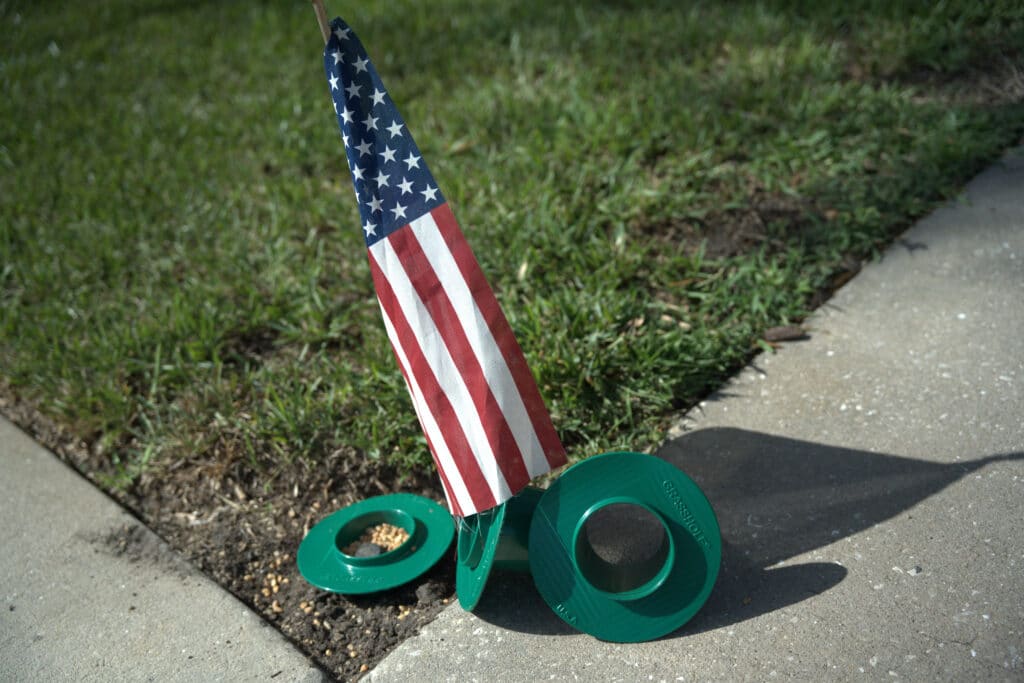
Sprinkler-Guard by Grasshole is designed as a preventative solution to sprinkler head damage and alignment problems. Made from advanced flexible ABS plastic, it adapts to soil movement rather than cracking under pressure.
When uneven lawn grading around sprinkler heads causes chronic dry spots due to soil settling, adaptive protection helps stabilize the soil evenly around the sprinkler head. It helps inhibit grass growth and reduces sinking that contributes to surface contour shifts.
It is not a quick remedy for poor grading. Rather, it functions as structural reinforcement within a smart irrigation plan.
By maintaining consistent head elevation and surrounding soil stability, sprinkler heads deliver intended spray arcs. Intended spray arcs promote balanced moisture distribution across both high and low sections.
Built super tough and made in the USA, it supports preventative maintenance rather than reactive correction.
Dry spots often occur when surface grading directs water away from certain areas, preventing consistent soil infiltration.
When soil settles unevenly, sprinkler spray distribution interacts with altered surface contours. Water may flow downhill or pool, leaving elevated areas under-watered.
Extended watering may temporarily mask symptoms but does not correct surface contour imbalance.
Yes. Adaptive protection like Sprinkler-Guard by Grasshole helps maintain even soil support around sprinkler heads, reducing settling that affects grading stability.
Look for subtle depressions, water pooling after irrigation, or persistent dry strips on slight elevations.
If dry spots reappear despite proper watering schedules and head alignment, evaluating surface grading and structural stabilization is advisable.
Recognizing why uneven lawn grading around sprinkler heads causes chronic dry spots reframes lawn care priorities.
Healthy lawns depend on consistent irrigation. Consistent irrigation depends on stable sprinkler heads. Stable sprinkler heads depend on balanced grading and supportive soil conditions.
As Angus McGrass might say with a calm smile, “Level the ground, steady the spray — and the grass will answer kindly.”
Stability beneath the surface creates resilience above it.